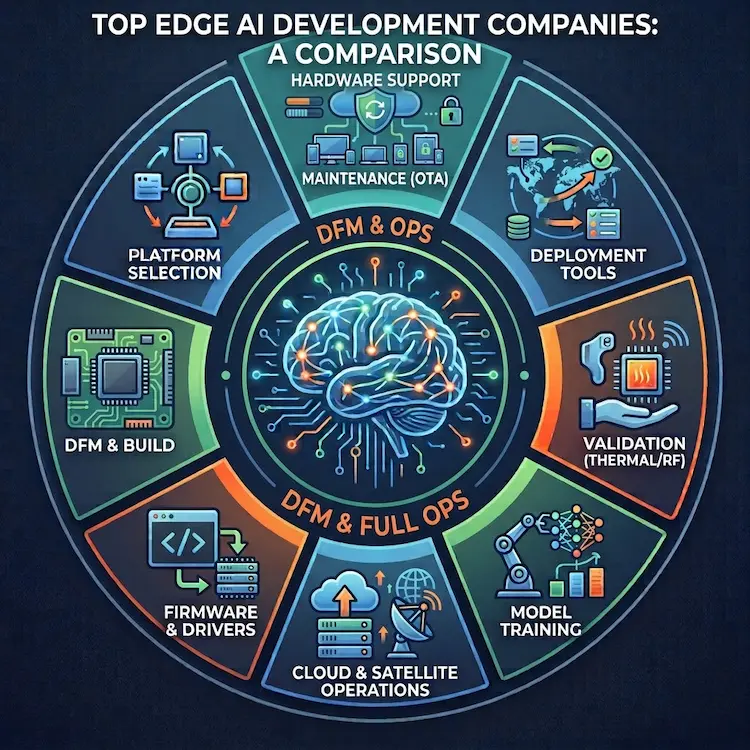
Top Edge AI Development Companies in 2026: Hardware Design and Engineering Support
Picking an edge AI development company sounds simple until you look at what each one actually builds. Some design the board and write the firmware. Others only train the model. A few do both, and many teams don’t find out which is which until the project is already moving.
That confusion matters more now, because demand keeps growing. In ZEDEDA’s 2026 survey of 600 IT and business leaders, 83% said edge AI is important to their core business strategy. So this guide shares a list of top edge AI development companies with a focus on hardware design and engineering support. For each one, we show which parts of the build they own, so you can build a shortlist and know exactly what to ask before you sign a contract.
What Hardware Design and Engineering Support Means in an Edge AI Project
Every edge AI project splits the work into the same layers, including:
- Silicon selection
- Board design
- Firmware
- Model development
- Compression
- Validation
- Deployment
- Maintenance after launch
What changes from vendor to vendor is where the line falls. What changes from project to project is whether both sides agreed on that line before work started.
Most disputes in this market are about scope. The model underperforms, and each side points at the other’s layer. The device overheats, but thermal work was never in the contract. A model update breaks a fleet, but nobody scoped the update system.
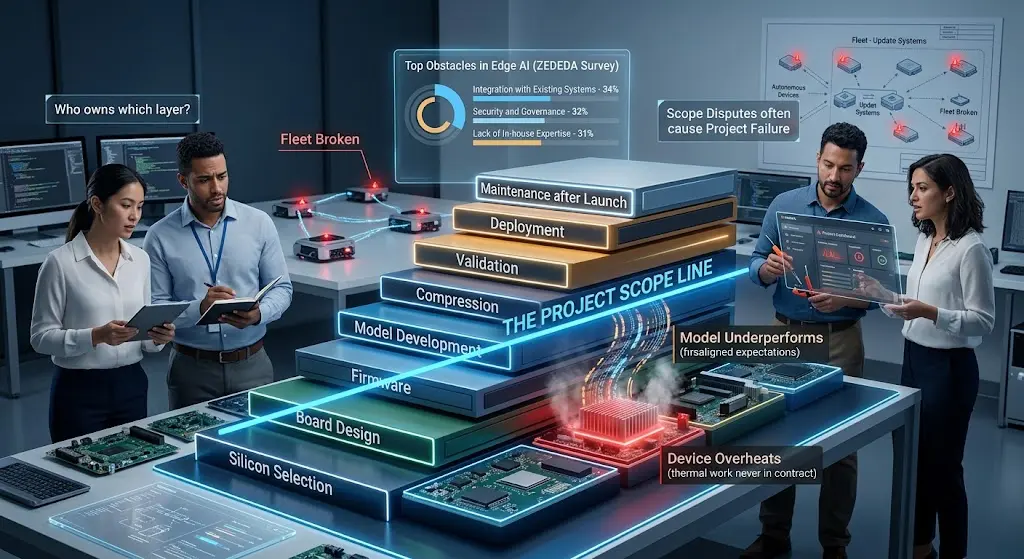
The same ZEDEDA survey shows how common these problems are. 34% of respondents named integration with existing systems as their top obstacle, followed by security and governance concerns at 32% and a lack of in-house expertise at 31%. Problems like these get worse when nobody agrees on who owns which layer.
That is why this list is organized by layer. Here is what each one covers the top edge AI development companies.
| Layer | What it covers | Where projects go wrong |
| Silicon and platform selection | Choosing the chip and platform. This decision shapes everything after it. | Vendors without hardware skills push it back to you or accept a platform they have not tested. |
| Board design and firmware | PCB layout, power management, sensor and ISP integration, drivers, RTOS or embedded Linux. | Providers either staff this or they do not. There is little middle ground. |
| Model development and compression | Architecture choice, training, quantization, pruning, and compiling for the target device. | Almost every vendor claims this layer, and skill levels vary more here than anywhere else. |
| Data pipeline | Collection planning, labeling standards, validation, and coverage of field conditions. | Often assumed to be the client’s job, and often the reason models underperform. |
| Physical validation | Thermal, optical, RF, and EMC testing. | Needs lab access that not every provider has. |
| Deployment and maintenance | OTA updates, staged rollout, rollback, drift monitoring, retraining. | Often left undefined because it starts after the delivery milestone. |
What to Check Before You Shortlist an Edge AI Development Company
Clarify the following things before you choose an edge AI development company.
- Written Layer Map: Ask each vendor to list which layers they staff in-house and which they subcontract. Also confirm what they expect from you. Get it in writing before the proposal stage.
- Data Ownership: Confirm who plans data collection and who sets labeling standards. This is the most common gap between assumed and actual scope.
- Validation Access: Ask where thermal and RF testing happens and who pays for it.
- Maintenance Terms: Confirm what happens after launch. Also, ask who updates the models and under what commercial deal. In the same survey, 41% of leaders said managing AI workloads across distributed edge environments is a real challenge, so do not leave this for later.
Edge AI Development Companies at a Glance
Here is a quick view of the seven providers and the layers each one covers.
| Company | Platform selection | Board design | Firmware | Models | Physical Validation | Updates and deployment |
| SQUAD | Yes | Yes | Yes | Yes | Yes | Yes |
| Conclusive Engineering | — | Yes | Yes | Ask | Partial (compliance) | — |
| ByteSnap Design | Yes | Yes | Yes | — | Partial (EMC) | — |
| Softeq | Yes | Yes | Yes | Yes | — | Partial (cloud) |
| deepsense.ai | — | — | — | Yes | — | Partial |
| Integra Sources | — | Yes | Yes | Partial (vision integration) | — | — |
| Witekio | — | — | Yes (BSP) | Partial (integration) | — | Yes |
A dash means the provider’s published information does not state it. Always confirm in writing.
7 Top Edge AI Development Companies in 2026
Here is the list of the best AI development companies that people are choosing for their layer framework.
-
SQUAD
Founded: 2016 | Team: 700+ | Focus: AI-powered cameras and connected devices, end-to-end
SQUAD staffs every layer in one company, so the layer map is short. The boundary sits at the edge of the product, not between disciplines inside it.
- Hardware and embedded: They use sensor and optics selection, PCB design, DFM and BOM optimization, antenna and mmWave radar integration, RF validation, and RTOS and embedded Linux firmware.
- Models: Built for constrained hardware from the start, using pruning, quantization-aware training, and hardware-aware optimization. Vision fuses RGB, radar, and PIR inputs to cut false alerts.
- Data: Staffed separately, with collection planning, multi-level review, and automated checks.
- Validation: 6,500 m² of in-house labs for optical, RF, EMC, and EM testing, plus signal and power integrity testing on real units.
- Maintenance: AWS, Kubernetes, Kubeflow, and Terraform back the pipelines that fleet updates rely on.
- Track record: 900+ projects, 70+ devices, and part cost cuts of up to 15%.
- Layers covered: All of them. Best fit for buyers who want one accountable party.
-
Conclusive Engineering
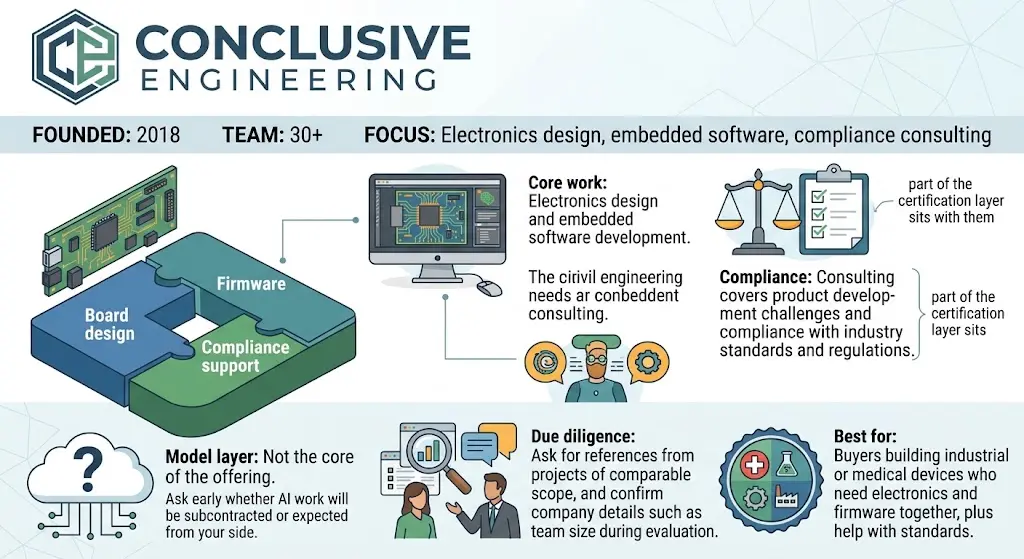
Founded: 2018 | Team: 30+ | Focus: Electronics design, embedded software, compliance consulting
Conclusive Engineering is a small team built around electronics design and embedded software. It focuses on hardware-software integration for industrial and medical devices. That makes it a good fit when the board and firmware must work as one. Artificial intelligence (AI) is not its core, so that layer needs a clear answer.
- Core work: Electronics design and embedded software development.
- Compliance: Consulting covers product development challenges and compliance with industry standards and regulations, so part of the certification layer sits with them instead of with you.
- Model layer: Not the core of the offering. Ask early whether AI work will be subcontracted or expected from your side.
- Due diligence: Ask for references from projects of comparable scope, and confirm company details such as team size during evaluation.
- Best for: Buyers building industrial or medical devices who need electronics and firmware together, plus help with standards.
- Layers covered: Board design, firmware, compliance support. The model layer requires clarification.
-
ByteSnap Design
Founded: 2008 | Team: ~37 | Focus: Embedded electronics and software consultancy
ByteSnap is a small consultancy where the same team handles hardware and software. That keeps the board and the firmware in one scope. It also moves part of the validation layer in-house. At about 37 people, it works as a focused engineering partner.
- Engineering: Embedded Linux and firmware, FPGA design, high-speed digital and PCB design, low-power wireless, and ATEX design for hazardous environments.
- Platform support: Partnerships with NXP, Microchip, Digi, and Arrow help when a client has not committed to a platform yet.
- Validation: An in-house EMC test chamber lets designs be prequalified during development, not after layout is frozen.
- Credentials: ISO 9001:2015 certified.
- Industries: Medical devices, EV charging, industrial systems, energy, automotive, and security.
- Watch for: The layers below do not include model development, so confirm who handles the AI work.
- Best for: Teams that want hardware, firmware, and early compliance testing under one roof.
- Layers covered: Platform selection, board design, firmware, EMC validation.
-
Softeq
Founded: 1997 | Team: 500+ | Focus: Hardware, embedded, IoT, AI and machine learning
Softeq is one of the larger names on this list, and it spans a lot of ground. Work runs from PCB layout and drivers all the way up to web and mobile apps. The team is big enough to support programs that run across several phases and years.
- Engineering: Hardware, firmware, embedded systems, cloud, and machine learning.
- Machine learning practice: Computer vision, robotics, wearables, and industrial automation workloads that need on-device inference.
- Published work: Driver-assistance and object-recognition software, remote process control, production-line automation, and connected healthcare devices.
- Clients include: Verizon, Epson, Lenovo, AMD, Verifone, Western Digital, and OMRON.
- Validation: Not listed in its covered layers, so confirm who handles physical testing.
- Maintenance: Cloud work is listed, but ask how model updates and rollbacks are handled.
- Best for: Multi-year programs that need hardware, embedded, and ML skills together.
- Layers covered: Platform selection, board design, firmware, model development, cloud.
-
deepsense.ai
Founded: 2014 | Team: 100–200 | Focus: AI consulting and custom model development, cloud-based storage
deepsense.ai is a model specialist. Hardware, firmware, and physical validation stay with you or another vendor, so the layer map is clear from day one. If your hardware is already settled, this is the kind of partner that fills the AI gap.
- Model work: Feasibility consulting, custom development, and production deployment on edge targets.
- Edge-relevant work: Defect detection and quality control using computer vision.
- Clients include: Sky, Zebra Technologies, Brainly, DocPlanner, and Hexagon.
- Engagement types: Full delivery or team augmentation.
- Hardware: Not covered. Pair it with an electronics partner if you need board work.
- Validation: Thermal, optical, RF, and EMC testing stay with you or another vendor.
- Watch for: Deployment support is listed, so ask how far that help goes.
- Best for: Teams with a shipping device or an embedded team that only needs a model partner.
- Layers covered: Model development, compression, deployment support.
-
Integra Sources
Founded: 2014 | Team: Not publicly disclosed | Focus: Electronics design and low-level software
Integra Sources pairs electronics design with low-level software. Hardware and software teams are often assigned to the same project, so both halves of an integration fall within a single scope. Its focus is industrial IoT and Industry 4.0.
- Software: Device drivers for Linux, Windows, and macOS, kernel modules for embedded targets, plus the middleware and system services beneath application code.
- Vision: Image and video processing, object tracking, and face recognition, built on that low-level base.
- Hardware: PCB design and layout, FPGA design, prototyping, and assembly.
- Track record: More than 250 completed projects and 100+ clients.
- Team size: Not publicly disclosed, so ask for staffing details early.
- Watch for: Platform selection, physical validation, and model training are not listed, so confirm who handles them.
- Best for: Industrial IoT products that need hardware and low-level software built together.
- Layers covered: Board design, firmware, drivers, vision model integration.
-
Witekio
Founded: 2001 | Team: 150–170 engineers | Focus: Chip-to-cloud embedded software and edge AI integration
Witekio covers the layer between a chosen platform and a running model. Its engineers build the software that gets a model working on real hardware, and it also addresses what happens after launch. It is an Avnet subsidiary.
- BSPs: Production-ready board support packages that use GPUs, NPUs, and DSPs for faster inference.
- Model tools: Integration of models from NVIDIA TAO Toolkit, TensorFlow Lite, PyTorch Mobile, Intel OpenVINO, and Edge Impulse.
- Sensors: Camera, microphone, and multi-sensor integration in the same practice.
- Maintenance: Secure data collection from devices, model updates, and transfer learning or federated learning to keep deployed models current.
- Engagement types: Fixed-price or dedicated team.
- Watch for: Board design and physical validation are not listed, so confirm who covers them.
- Best for: Teams that have chosen a platform and need a model running on it, with a plan for updates.
- Layers covered: Firmware and BSP, accelerator integration, model deployment, update path.
Upload your project files today and request a free quote to get started..
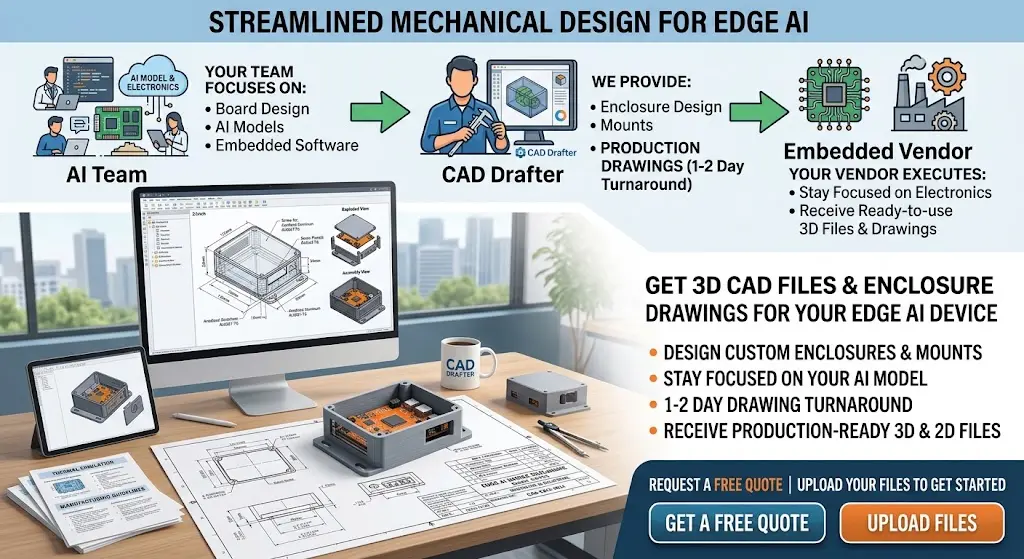
Need Enclosure Drawings or CAD Files for Your Edge AI Device?
Most edge AI teams focus on the board and the model, then find out late that the device still needs a housing, mounts, and production drawings. If that sounds familiar, our team at CAD Drafter can take that work off your plate. We don’t build the electronics or the model. We handle the mechanical drawings and 3D files around them, so your embedded vendor can stay focused on its own layer. Most drawings come back in one to two days. You can request a free quote or upload your files to get started.
Which Type of Partner Fits Your Project
The right split depends on what you already have.
| Your Situation | What You Need | Providers to Look at First |
| You have an embedded team and a shipping device, and only need AI | A model partner | deepsense.ai, Witekio |
| You have a concept or board and need firmware, drivers, or compliance help | Embedded and electronics depth | Conclusive Engineering, ByteSnap Design, Integra Sources |
| You are starting from a product idea | One party across most or all layers | SQUAD, Softeq |
Conclusion
Before you sign anything, sit down with each vendor and ask one plain question: who does what? That’s the whole game. If you already have a working device and your own firmware people, you probably just need someone for the model. Paying a full hardware team you won’t use is wasted money. Starting from a rough idea is different.
You’ll want one partner who can cover most of it, since juggling four small vendors means you end up as the project manager and the referee. Use the layer table above as your checklist. Either way, get it on paper. Who collects the data? Who pays for the thermal and RF tests? Who pushes model fixes after launch? An hour on this now beats months of arguing later.
FAQs
What does hardware design and engineering support cover in an edge AI project?
Mostly the physical side of the device. That means picking the chip, laying out the board, handling power, connecting sensors, and writing the firmware and drivers. Good providers also test the finished unit for heat, radio, and EMC problems.
Which companies offer both hardware and AI work?
SQUAD handles every layer with its own staff. Softeq is the next closest, with hardware, firmware, ML, and cloud work. The rest lean one way or the other, so check the comparison table before you reach out.
Is one full-cycle partner better than several specialists?
It depends on where you’re starting. With only a concept, one partner means fewer handoffs and less integration risk. If you already have a board and an embedded team, hiring a model specialist on its own is usually cheaper.
Who pays for thermal, RF, and EMC testing?
There’s no standard answer. Some vendors run their own labs and fold testing into the price. Others send the work out and bill you for it. Ask early and get the answer in the proposal.
What should a contract say about updates after launch?
Name who updates the models, how updates reach the devices, what happens if one fails, and what it costs. Teams skip this because the work starts after delivery, then scramble once devices are already in the field.