
Civil Engineering Costs Explained: Fee Structures, Rates, and Full Project Budget Breakdown
Ask five architects what civil engineering should cost, and you will get five different numbers. None of them are wrong, and none of them are useful without context. That is the problem with civil engineering fees. They are not fixed, but they are changing with site conditions and project size.
If you are making a budget for your construction project, then you need more than a rule-of-thumb percentage for a civil engineer fee. You have to understand how fees are structured and what actually moves the numbers.
In this guide, we will break down the fee structure, rates by job roles, realistic budget ranges by project size, and what should be in your scope. So, next time someone asks you what civil engineering is going to cost us, you have got a real number.
How Civil Engineering Fees Are Structured?
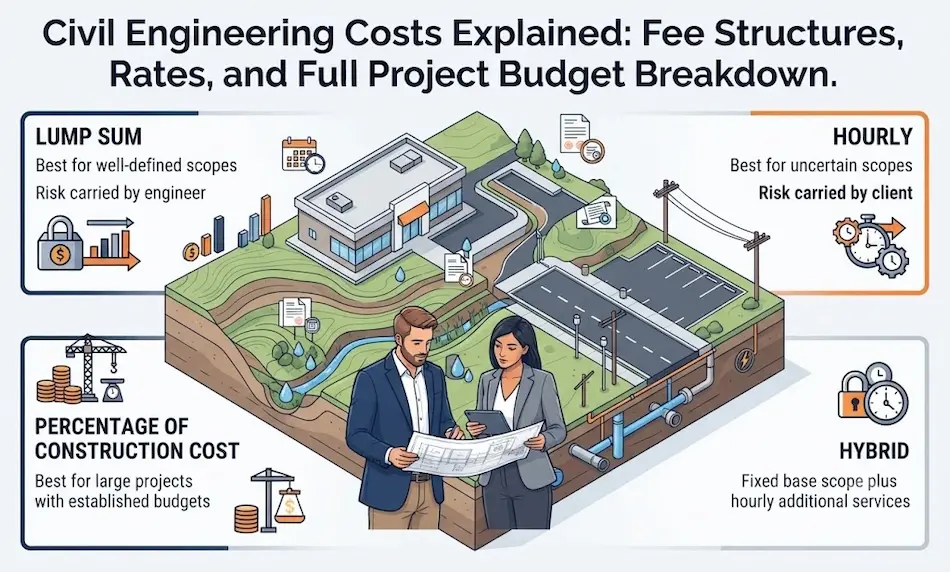
Before you get to know the numbers for civil engineers’ fees, you need to know the fee model through which they are charged. Here we are going to mention the four common fee structures civil engineering proposals generally fall into.
● Lump Sum Fee
This is the most common approach for well-defined scopes, such as a drainage plan for a single building or a site plan for a small commercial pad. In this fee model, the engineer prices specific deliverables up front, and the total fee is fixed regardless of how many hours it actually takes. Engineers are responsible for the schedule and scope of work. That is why it is important to have a detailed section for scope of work in the contract. Because vague scope under a fixed fee creates disputes at a later stage.
● Hourly Rates
Hourly rates fee structure is used when scope is generally uncertain or for entitlement processes with unpredictable timelines. In this fee structure, engineers bill by the hour with a not-to-exceed cap to protect the client’s budget while preserving flexibility. This model shifts risk toward clients, but bets fit when nobody predicts how much effort is actually required for the task.
● Percentage of Construction Cost
This fee model is basically designed for public construction projects where a budget is established earlier. In this model, fees scale with project size and complexity. It sounds fair in theory, but in reality, this structure creates a subtle misalignment as the engineer is not incentivized efficiently if their fee grows with the construction cost.
● Hybrid Fee
In this model, a lump sum covers the base scope, and additional services like SWPPP preparation or scope changes get billed hourly against an agreed budget. You will see this fee structure in mid-size private development work because it gives cost certainty on the predictable parts while leaving room for the unpredictable parts.
|
Fee Model |
Best Used When |
Who Carries the Risk |
| Lump Sum | Scope is well-defined | Engineer |
| Hourly | Scope is uncertain | Client |
| % of Construction Cost | Large projects, established budgets | Shared, loosely |
| Hybrid | Mid-size projects with predictable base scope | Split by scope category |
Civil Engineering Rates by Occupational Roles
Civil engineering is not one profession with one fixed rate card. It has different occupational roles, each pricing labor differently based on specialization, licensure requirements, and regulatory exposure.
Here are the major occupational roles of the civil engineering field.
- Civil Engineering Technologies & Technicians:
These professionals support licensed engineers with drafting, field data collection, and routine calculations. They work under supervision and typically don’t stamp deliverables. Most civil engineers start their career from this level.
- Architectural and Civil Drafters
Architects and drafters produce technical drawings and construction documents from engineers’ designs and specifications using CAD software. They focus on drawing production rather than engineering analysis or decision-making. It is the most cost-effective role for high-volume drafting work on a project.
- Architectural and Engineering Managers
They oversee engineering and design teams, manage project delivery, and hold ultimate technical and business responsibilities for a firm’s work. It is generally the most senior and highest-billing role in a project team. They are considered the point of contact for major clients and agency relationships.
- Environmental Engineers
Environmental engineers design systems and studies that address water quality, waste management, and environmental compliance. This profession overlaps with civil site development on stormwater and permitting issues. They closely work with the civil team on regulatory sites.
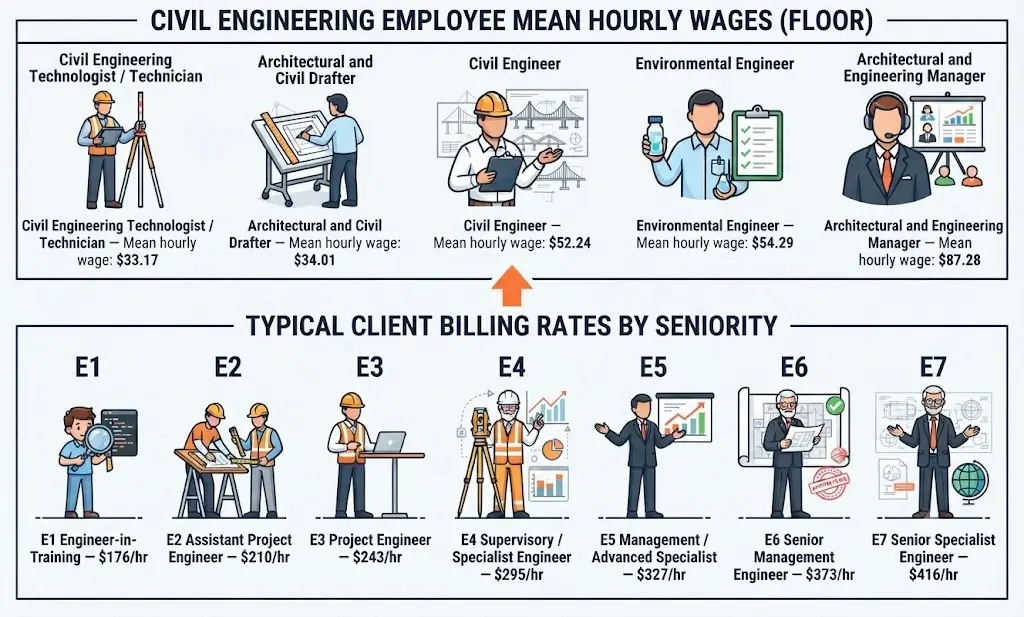
Here is the table that states the wages of all these occupational roles given by the U.S. Bureau of Labor Statistics, Occupational Employment and Wage Statistics,
| Occupation | Mean Hourly | Mean Annual | Median Hourly |
| Civil Engineers (all specialties) | $52.24 | $108,670 | $48.48 |
| Civil Engineering Technologists & Technicians | $33.17 | $68,990 | $31.23 |
| Architectural and Civil Drafters | $34.01 | $70,740 | $31.80 |
| Architectural and Engineering Managers | $87.28 | $181,540 | $82.34 |
| Environmental Engineers | $54.29 | $112,910 | $51.50 |
Consider these wages as a floor, not a ceiling. These are paid to employees, not what civil engineering companies charge a client for their time. To see how wages translate, explore the next table where we outlined wages per hour for each profession based on seniority level.
| Seniority Level | Role | Rate/Hour |
| E1 | Engineer-in-Training | $176 |
| E2 | Assistant Project Engineer | $210 |
| E3 | Project Engineer | $243 |
| E4 | Supervisory / Specialist Engineer | $295 |
| E5 | Management / Advanced Specialist Engineer | $327 |
| E6 | Senior Management Engineer | $373 |
| E7 | Senior Specialist Engineer | $416 |
Why Does Knowing Civil Engineering Rates Matter in Budgeting?
Civil work shapes your site plan and permits that directly affect your construction budget and timeline. Most estimating teams guess the civil engineering rate at the early stage of the project with the intent that they will fix the numbers later. That habit causes problems because it is harder to change these numbers at a later stage.
You scramble for more budget in the middle of the project if you underestimate the fee upfront. Knowing the realistic rate of civil engineering work before you start lets you build a budget you can actually stick to and catch missing scope before it turns into costly surprises.
Factors that Drive Civil Engineering Costs Up
Civil engineering fees don’t jump randomly without any reason. Some factors cause this increase. Knowing them ahead of time helps you spot where your budget is likely to grow.
- Stormwater and regulatory requirements: Sites with stormwater rules (SWPPP plans, local drainage ordinance, or MS4 permit requirements) take more engineering hours to design and more rounds of review to get approved by the agency. The more regulated your site, the higher the engineering fee.
- Site conditions: Steep slopes, poor soils, floodplains, or existing structures all add complexity in civil work. Likewise, a site with drainage problems or unstable soil needs extra analysis and sometimes separate geotechnical engineering. All of that leads to higher engineering rates. A flat and clean area is easy to design around.
- Number of permitting agencies involved: Some projects only need sign-off from one local planning department. While others need approval from multiple government agencies or utility companies. Each has its own review process and comment rounds. Every additional agency usually means more coordination hours that add cost fast.
- Project type and use: A single-family lot and an industrial site with heavy truck traffic are not priced the same for civil work. Higher intensity uses usually come with stricter code requirements and more design iterations.
- Level of construction documentation needed: A basic site plan for early feasibility costs far less than a full construction-ready drawing set with detailed specifications. If your project needs highly detailed documents for permitting, expect the fee to be higher for the higher level of precision.
- Site size and scope: Bigger sites generally mean more design work and more drainage calculations. But size is not the only driver for higher fees. A small site with heavy regulatory requirements can also cost more than a larger project. So, size and scope both matter.
Note: None of these factors are hidden. A good civil engineer should walk through which ones apply to your project and how they affect the number. If a quote seems high or low, consider these factors to get the accurate fee range.
Contact CAD Drafter today for professional civil drafting services and keep your project moving with confidence.
Sample Budget Breakdown by Project Scope
Civil engineering fees don’t scale based on the project size. Smaller projects often pay a higher percentage of construction cost because a lot of the design work stays the same whether the site is small or large. Below, we have given three sample budget breakdowns of three projects based on the scopes.
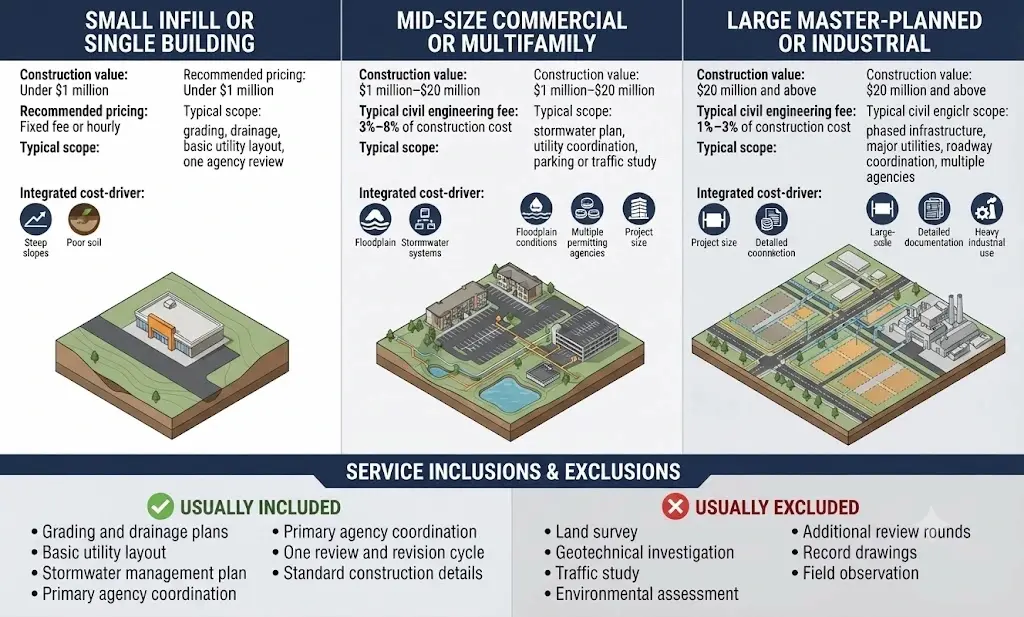
1. Small Infill or Single Building
Think of a single home or a small infill lot in an existing neighborhood that has typically under $1 million in construction cost. The scope of this project is limited to a grading and drainage plan, a basic utility layout, and one round of agency review. At this size and scope, a flat percentage of construction cost is not reliable, so time-based or fixed-fee pricing is the recommended approach instead.
2. Mid-Size Commercial or Multifamily
This covers projects like a small apartment building, strip retail, or a mid-size office project. These types of projects have construction costs between $1 million and $20 million. The scope of these projects covers a full stormwater plan, utility coordination, and often a parking study. For these mid-size commercial projects, percentage-of-construction-cost pricing becomes practical and the recommended rate steps down as the budget grows.
3. Large or Master-Planned
This includes large residential developments and industrial sites with heavy infrastructure needs. The construction costs for them start from $20 million up into the hundreds of millions. Scopes often include phased design, extensive utilities, and roadway coordination. Civil engineering fees for these projects are the largest in dollar terms, but smallest as a percentage of construction cost. A scope-based fee structure is the perfect fee module for them.
Here is a budget range extracted from ACEC-BC, Budget Guidelines for Engineering Services, for civil engineering work based on project scope
|
Project Scope |
% of Construction Cost |
What is the Reason for the % |
| Small infill / single building | Percentage method not recommended — use time-basis or fixed-fee instead | Base scope stays fixed regardless of size; small budget makes the percentage look high |
| Mid-size commercial / multifamily | 3%–8% | More coordination and studies, but spread across a larger construction budget |
| Large / master-planned or industrial | 1%–3% | Base scope becomes a smaller share of a much larger total budget |
What is Typically Included and Excluded in Civil Engineering Fee?
The most common source of budget surprises is not the civil engineering fee itself. It is assuming a quote that covers more than it actually does. Every firm writes their proposal for civil engineering work a little differently. But when you look closely, most quotes follow the same basic split, including some fixed base fee and some gets billed on top of it.
| What is Included in a Base Civil Engineering Fee? | What is Excluded in a Civil Engineering Fee? |
| ● Grading and drainage plan for the site
● Basic utility layout ● Stormwater management plan, sized to meet local requirements ● Coordination with the primary permitting agency ● One round of agency review comments and revisions ● Site plan review support during the permitting process ● Standard construction detail drawings |
● Land survey
● Geotechnical investigation and soils report ● Traffic impact study or parking analysis ● Environmental assessment or wetlands delineation ● Construction administration or field observation ● Construction staking ● Additional rounds of agency review beyond the first ● Coordination with secondary agencies ● Record drawings after construction |
How to Evaluate a Civil Engineering Fee Proposal?
A civil engineering fee is easy to compare on the surface because it is one number. It is tempting to just pick the lowest one. But this fee impacts the overall productivity of your project. That is why you must evaluate this by keeping in mind the following key points.
● Match the Fee to the Scope
When you get a proposal for a civil engineering fee, the first thing you must do is to look at what each number is attached to. Does the proposal list specific deliverables, or does it use vague language like ‘all civil engineering services’ for one flat fee? A fee tied to unclear scope is the place where disputes are created at a later stage. So, it is important to know exactly what the fee buys before making any decision.
● Ask for the Fee Broken Down by Role
If your fee is hourly or hybrid, ask for a rate schedule by role, instead of getting one blended number. This schedule tells you whether you are paying senior rates for architectural drafting work and allows you to check the fee against published benchmarks.
● Check Which Fee Structure You’re Actually Being Quoted
It is also good to check whether the fee is lump sum, hourly, percentage of construction cost, or hybrid. Additionally, make sure the given fee structure matches the project stage. In the previous section, we have covered which method fits which situation. You can take guidance to get to know the exact fee structure.
● Compare Fees Apples to Apples
A lower fee generally means less is included, not that the firm is more efficient. When you get multiple proposals for civil engineering fees, line up each proposal’s fee against the included/excluded checklist from earlier. This cross-checking helps you to separate a cheap or incomplete proposal from a complete one.
Conclusion
Civil engineering fees are not a random number. Multiple factors shape them, including fee structure, project size, and scope. Occupational roles also directly affect the civil work fee. Professionals in higher managerial roles with technical experience usually get higher salaries compared to junior-level roles.
However, it is quite difficult to pick one price quote from multiple engineering firms. If you have received multiple fee proposals, check whether the scope matches the fee, verify what is included, ask for a fee breakdown by role, and compare fees apples-to-apples. The next time a civil engineering proposal lands on your desk, you will know exactly what to check by following these tips.
Still need help getting your civil drawings scoped, drafted, or reviewed? CAD Drafter connects you with experienced civil drafting professionals who can turn your project requirements into accurate and permit-ready drawings.
Frequently Asked Questions
How much does civil engineering cost as a percentage of a construction project?
Civil engineering cost generally runs 1% to 15% of the total construction cost, depending on project size and complexity. For smaller, straightforward projects, this percentage tends to be 1% to 4%. For complex construction projects, this percentage tends to be on the higher end.
What is the difference between civil and structural engineering fees?
Civil engineering covers site work including grading, drainage, and utilities. On the other hand, structural engineering covers a building’s load-bearing design. Engineers from both fields charge differently, depending on the project’s size and complexity.
When should I lock in civil engineering scope during design?
It is good to lock in the civil engineering scope during the schematic design phase. Early civil input on utilities and stormwater constraints prevents costly rework later and keeps your civil consultant’s fees aligned with your actual site conditions.
How do I know that a civil engineering quote is fair?
A fair quote lists specific scope, named agencies, and exclusions clearly. To get to know you have got the fair quote, compare itemized deliverables instead of just totals. Also, get two or three comparable bids to ensure scope matches.
Are civil engineering fees negotiable?
Yes. You can negotiate the fees in the following ways:
- Reducing the project scope
- Handling the permitting logistics yourself
- Removing unnecessary contingency tasks
- Securing multiple competing bids to use as price leverage

