
How Is Wearable Technology Transforming Construction Safety in 2026?
According to the 2026 report of the U.S. Bureau of Labor Statistics, 1,032 construction and extraction workers died from workplace injuries in 2025. That indicates that construction sites are the deadliest sectors to work in. These are just numbers; they are the real workers who never made it home to their families.
Behind every one of those numbers is a preventable moment: a missed hazard, a fall from height, or a machine that got too close. But 2026 is bringing new hope. Construction sites are starting to use technology to fight back. Wearable technology is becoming one of the most useful tools, a core part for spotting danger early before it turns into tragedy.
In this guide, we will share details about how this technology is transforming the construction site into a safe working place. Let’s get started.
Why Construction Needed Its Own Wearable Category?
Consumer wearables like fitness trackers and smartwatches are designed for monitoring every task. They count steps, monitor sleep, and sync with smartphones. These simple devices are not built to survive a fall from scaffolding or eight-hour shifts in extreme heat.
Construction sites demand a different standard for wearable technology. These devices need to withstand drops and harsh weather while still delivering accurate and real-time data. That is why the construction industry has developed its own category of wearables to tackle specific jobsite problems rather than daily lifestyle use.
This shift is reflected in market growth. A 2026 report from Future Market Insights values the global construction wearable technology market at approximately $5.09 billion, with an estimated projection of $7.55 billion by 2030. This growth shows that construction wearables are no longer experimental. They are becoming a standard part of how the industry manages worker safety and site operations.
Core Applications of Wearables on Construction Sites
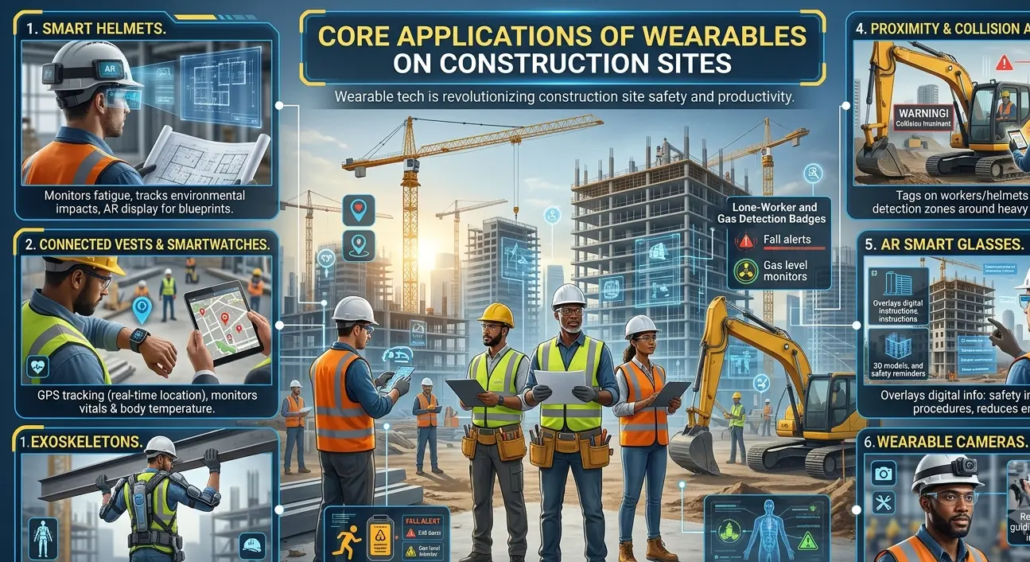
Wearable devices are already being used across construction sites in several ways. Each of them addresses a specific productivity gap. Here are the most common applications of wearable technology in construction.
● Smart Helmets
In the construction industry, traditional hard hats are now being replaced with smart versions of helmets with built-in sensors. These helmets can monitor fatigue levels and track environmental impacts. Some helmet models also include augmented reality displays that allow workers to view blueprints directly in their line of sight.
● Connected Vests and Smartwatches
Safety vests and smartwatches equipped with GPS are great inventions of wearable technology. These devices allow supervisors to track workers’ locations in real time. They are especially useful on large-scale sites where visual contact with every worker is not possible. Additionally, these smart devices monitor vital signs and body temperature, which helps in identifying early signs of heart stress or overexertion before they become serious.
● Environmental and Gas Sensors
Construction workers are often faced with hazardous conditions such as exposure to toxic gases or extreme temperatures. Advanced vests or helmets with built-in wearable environmental sensors monitor these conditions continuously. If an unsafe level is detected, the device can trigger an alert and give workers time to move to a safe place.
● Exoskeletons
Worker often lifts heavy weights during construction work that may cause musculoskeletal injuries for contractors. Exoskeletons are greatly useful devices that are worn across the back, shoulders, or arms to reduce physical strain during lifting tasks. These devices support proper posture and reduce fatigue. They also help workers perform physically demanding work with less risk of injury.
● Proximity and Collision Avoidance Devices
Heavy machinery is one of the biggest hazards on any construction site. Proximity sensors are a great solution that can prevent this hazard. These sensors are often worn as tags on a helmet or vest and create a detection zone. In case of any danger, both the worker and equipment operator receive an alert and reduce the risk of any unexpected accidents.
● AR Smart Glasses
Augmented reality glasses coat the digital information directly onto the worker’s physical construction site. This information can include safety instructions or any reminders for specific procedures. AR glasses help in reducing errors caused by missed steps or overlooked protocols by placing this information directly in a worker’s field of view.
● Wearable Cameras
Body-mounted or helmet-mounted cameras ensure safety and quality control. These cameras allow remote experts to guide on-site workers through complex tasks in real time. The best part of these devices is that they remove the need for travel, which eventually speeds up problem-solving. Furthermore, these cameras are used for making documentation to maintain compliance records.
● Lone-Worker and Gas Detection Badges
Workers operating alone or in remote areas of a construction site face added risk if a little incident goes unnoticed. Lone-worker devices are specifically designed for these circumstances. They have built-in features of fall detection or man-down alerts that automatically notify supervisors if a worker becomes unresponsive. Furthermore, personal gas detection badges add a layer of protection that monitors air quality around individual workers.
In conclusion, these devices give construction teams something they didn’t have before, such as real-time visibility into worker health, location, and environmental risk. Instead of waiting for an incident to happen, these devices empower supervisors to catch warning signs and avoid any dangerous situation.
| Wearable | Where It’s Worn | What It Does | Key Benefit |
| Smart Helmets | Head | Detects impacts, monitors fatigue, tracks environmental changes | Warns workers before drowsiness or an impact leads to a serious injury |
| Connected Vests & Smartwatches | Torso / Wrist | GPS location tracking, heart rate and body temperature monitoring | Enables faster emergency response and early detection of heat stress |
| Environmental & Gas Sensors | Vest, helmet, or wristband | Continuously monitors toxic gases, noise levels, and extreme temperatures around the individual worker | Moves with the worker, unlike fixed sensors, closing gaps in hazard detection |
| Exoskeletons | Back, shoulders, arms | Supports posture and reduces strain during lifting | Lowers risk of long-term musculoskeletal injury |
| Proximity & Collision Avoidance Tags | Helmet or vest | Creates a detection zone around heavy machinery | Reduces struck-by accidents involving equipment |
| AR Smart Glasses | Eyes | Overlays safety instructions, task reminders, or equipment guidelines directly into the worker’s field of view | Cuts down on missed steps and small oversights |
| Wearable Cameras | Body or helmet | Streams live footage for remote expert guidance | Speeds up troubleshooting and improves incident review |
| Lone Worker & Gas Detection Badges | Vest or badge | Fall detection, man-down alerts, and personal air quality monitoring | Protects isolated workers who might otherwise go unnoticed |
What Does Wearable Technology Do in Construction Sites Beyond Safety?
Safety is the clearest reason why construction companies are investing in wearables, but it is not the only one. There are various business advantages behind using these devices that go beyond reducing incidents.
● Faster Emergency Response
When an accident happens on the construction site, then its response time greatly influences the level of damage. Wearables with GPS tracking give supervisors a worker’s exact location instantly. This avoids losing time trying to figure out where someone is on a multi-level site. That head start can make a real difference in how quickly help arrives.
● Productivity Gains
Fewer injuries mean less downtime. A single unexpected incident can pull a crew off schedule for days, and sometimes it takes months to manage the situation. Wearable devices that catch problems early help to avoid these disruptions in the first place. Augmented reality glasses also speed up the training and onboarding process for new joiners by guiding them through real-time instruction rather than relying only on verbal instructions.
● Cost and Insurance Impact
The financial consideration is essential in integrating wearables in the construction business. According to a 2026 report from The Law Offices of Eric Richman, employers save between $4 and $6 for every $1 invested in construction safety programs. The same report stated that companies that invest in safety programs and devices earn 21% higher profits and 17% greater productivity compared to those who don’t invest. Additionally, fewer injuries mean fewer workers’ claims for compensation, which eventually reduces insurance costs for a company.
● Regulatory and Compliance Pressure
Beyond the financial advantages, there are growing compliance concerns that wearable technologies address. Regulatory bodies like OSHA continue to introduce strict compliance expectations around jobsite safety. Companies that can show real-time monitoring during inspections can document better for submission to regulatory authorities.
Put it all together. Wearable devices are gaining popularity in the construction industry because it addresses issues apart from safety concerns. Along with saving workers’ lives, they protect budgets, timelines, and a company’s standing with regulators.
Underlying Technology Trends Powering These Devices
The wearable devices typically don’t work in isolation. Behind each smart helmet, vest, or sensor, there is a set of underlying technologies that make the whole system possible. Knowing these concepts helps in understanding why these devices have become so much more capable in recent years.
● AI and Machine Learning
Traditional safety devices could only react after something happened. Modern wearables are based on a proactive approach. AI can start recognizing signs of fatigue or heat stress before a worker even notices them by continuously analyzing data about movement patterns or body temperature. AI and machine learning empower these devices enough that they flag risk before an incident occurs.
● IoT Connectivity
The real value of wearables comes from being connected with IoT. Through Bluetooth, GPS, and cloud-based dashboards, individual devices link into a single site-wide safety system. With the help of these connectivity technologies, a supervisor doesn’t need to check each worker separately. They can overview the entire site’s safety status from one dashboard on which individual alerts are flagged automatically when some task needs attention.
● Miniaturization and Battery Life
None of the wearable devices work if they are too bulky or die halfway through a shift. Compatible hardware and long battery life made it possible to wear these devices comfortably and use them on multi-shift days. Moreover, they also hold up across different weather conditions without putting extra bulk on workers.
Call Us and Learn More About Construction Equipment
● Accuracy and Privacy
As these devices are becoming more common, trust in them matters as much as the technology itself. Workers and employers alike demand three things in these devices:
- Whether the readings are accurate
- If the device is reliable through a full shift
- How personal health and location data is stored and used.
In an industry setup, these concerns carry extra information because the data collected can affect compliance records, insurance claims, and workers’ privacy concerns.
Thus, these technology trends explain why wearables have been transforming from a novelty to a genuinely useful safety tool. Now, the technology is not limited to wearing a sensor. It has become connecting a sensor to a system that can actually act on what it detects before small issues become serious ones.
Challenges to Adopt These Wearable Devices
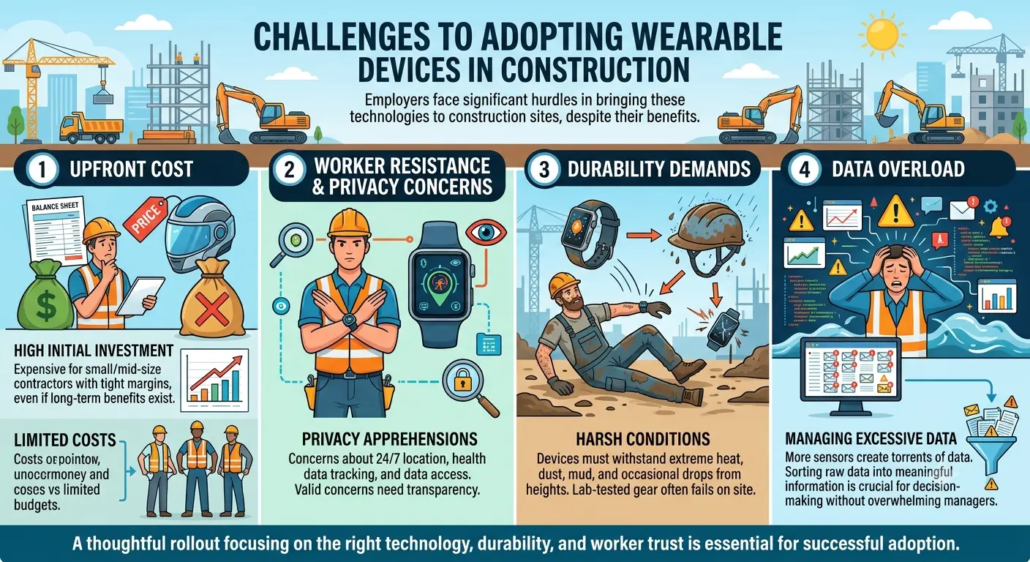
There is no doubt that wearable technology has numerous advantages for construction sites, but this adoption has not been that simple. Employers face several challenges to bring this technology on their construction sites.
● Upfront Cost
Smart helmets and exoskeletons are not cheap, especially when a company needs to supply these devices to an entire crew rather than a few workers. Large contractors can easily absorb these expenses. But for small and mid-size construction contractors, the cost of these technologies can make up a large share of their margin. The upfront investment can be a real barrier even if they offer long-term benefits.
● Worker Resistance and Privacy Concerns
Not every worker is comfortable with 24/7 tracking throughout the day. Devices that monitor location or other health data can feel invasive even when the intention is just safety. This concern of the workers is valid an dcannot dismissed. Companies need to be transparent about what data is being collected and who has access to it while incorporating wearables in their workplace. Platforms that skip these precautions often face pushback regardless of how useful the technology actually is.
● Durability Demands
It is not necessary that a device that works in a lab or office perfectly automatically survive a construction site. Dust, mud, extreme heat, and occasional drops from height are normal on the site. That is why wearables that are used for construction need to hold up to these conditions.
● Data Overload
More sensors mean more data required to run a system smoothly. Supervisors can end up overwhelmed with unnecessary alerts if the right systems are not in place to sort this data and highlight what actually matters. We can say that turning raw data into clear information is just as important as collecting it in the first place.
Thus, these challenges don’t mean wearable technology is not worth adopting. They simply mean that a thoughtful rollout to identify what works best and durables matters just as much as the technology itself.
The Future of Wearables on Construction Sites
Wearable technology on construction sites is still evolving, and where it’s moving looks even more connected than where it stands today.
Below are some predictable innovations that are supposed to overlap with these devices.
● Integration with Digital Twins and BIM
At the moment, most wearables operate as standalone devices that track a worker’s health or location. The next goal of technical experts is to tie this data directly into a site’s digital twin or Building Information Modeling (BIM) simulation.
With the help of this advanced technology, supervision could see that location mapped directly against the building’s structure to get the exact location of the worker for identifying whether that area has been cleared for work. This kind of integration turns wearables from isolated devices into a real-time picture of the entire project.
● Offer Predictive Safety
It is true that today’s wearables are already moving from reacting to incidents towards catching warning signs early. The next stage is using patterns in a worker’s data over days or weeks to predict fatigue, heat stress, or injury risk before it becomes visible.
With this new advancement, when a single heart rate spike occurs, a specific signal is generated indicating that a worker has been trending toward exhaustion over several days. This will help supervisors step in before it turns into an accident.
● Introduction of More Capable Devices
Right now, a worker has to wear several devices such as a smart helmet, a connected vest, or a proximity tag simultaneously. It is expected to consolidate the functions of all these devices. AR glasses are positioned to combine location tracking, hazard alerts, and task guidance. So, it reduces the need to layer multiple devices just to get full coverage.
Thus, none of these advancements replace the fundamentals of construction safety. But as the technologies upgrade and connect more closely with the entire system, wearables are likely to shift from a helpful add-on to an essential part of monitoring construction sites day to day. If you are confused about the integration of these tools in the construction field, CAD Darfter experts can help you understand these wearables.
Conclusion
Construction is one of the most dangerous industries to work in, but the tools designed to protect workers have changed significantly over time. Now, wearable technology has moved from a novelty to a genuine safety essential on the construction site. This technology gives supervisors real-time visibility into hazards, fatigue, and worker location across an entire construction site.
Smart helmets, connected vests, exoskeletons, and AR glasses are not replacing safety protocols in construction. Instead, they are strengthening them with data that was not available before.
Moreover, there are challenges to adopting this technology, and they are worth taking seriously. But as the technology connects more closely, wearables are strong candidates to become essential for maintaining construction safety.
Frequently Asked Questions
What is wearable technology in construction?
Wearable technology in construction refers to smart electronic devices that are particularly designed for on-site workers to improve safety and productivity. These smart devices include:
- Helmets
- Sensory vests
- Exoskeletons
- Digital monitors
- Sensory boots
- And more
Utilizing these small devices provides real-time data to workers to minimize workplace injuries and streamline field communication.
How do wearables improve safety on construction sites?
Wearable devices improve construction safety by monitoring workers’ real-time vitals, tracking locations, and instantly detecting falls. Each device has a distinct purpose, such as
- Smart helmets and sensor-mapped vests inform supervisors of hazards or collisions and enable emergency responses.
- Powered exoskeletons are outstanding wearable devices that reduce physical strain and prevent long-term ergonomic injuries.
- If you want to monitor workers’ daily health conditions, digital monitors are designed for you that analyse the heart rate of workers at all times.
Are construction wearables expensive to implement?
The initial costs for hardware and software integration for these devices can be high, but these are not expensive when considering long-term savings. Because they drastically reduce costly workplace injuries and boost on-site productivity. Thus, the return on investment for these devices quickly outweighs the upfront purchasing expenses.
Do workers have privacy concerns about wearable devices?
Yes, construction workers often raise privacy concerns regarding the continuous location tracking and personal health monitoring. Therefore, contractors must establish transparent data policies to build workers’ trust. The best way to build this trust is by restricting location tracking to work hours and securing all workers’ personal data.
What types of wearables are most common in construction today?
The most common construction wearables include the following:
- Smart helmet with GPS tracking
- Sensory safety vests that monitor vitals
- Smart boots that prevent falls
- Augmented reality glasses with real-time plan overlays
- Mechanical exoskeletons that reduce muscle strain

