
Is CAD Drafting A Good Career Choice In 2026?
Absolutely. CAD drafting is a solid career choice in 2026. Reports say that the CAD drafting workforce will reach 2.3 million by 2026, expected to grow at a 4.2 CAGR. But it is a good option for those professionals who are willing to evolve with the technology.
The days are gone when drafters simply trace lines on screen. Now CAD professionals are required to work alongside AI-powered tools. This shift raised serious concerns about the worth of pursuing this career.
In modern construction, industries still rely on skilled drafters who know how to turn structural concepts into buildable plans. In this blog, we will break down the real career prospects, salary expectations, required skills, and future outlook for CAD drafting in 2026. Let’s get started.
What are the Career Prospects of the CAD Drafting Field?
The good news for the aspiring drafter is that the CAD drafting field is not dying. It is actually booming if you know where to look. According to the U.S. Bureau of Labor Statistics, the number of drafting jobs is expected to increase 10% roughly from 2024 to 2034; about 16,200 new job openings pop up every single year.
Most of these jobs come from retired drafters or their movement from other careers, which means there is always room for new people in this field. Additionally, the pay is decent too for this job, which attracts a lot of freshers.
But there is one most important thing that you should consider: not every drafting job has the same prospects. For instance, traditional repetitive 2D drafting is slowly being replaced by automation and outsourcing. On the other hand, professionals who learn new skills like BIM and automation tools are in higher demand.
So, the crux of this discussion is that CAD drafting is not going anywhere it is just transforming. Your career prospects in this field totally depend on the skills you choose to build your career.
Salary Potential and Job Security in CAD Drafting
What is the salary and job security? Generally, it is the first question that anyone asks before choosing a career, and CAD drafting is no exception. The best thing about this career is that it offers a realistic career path to a handsome income without requiring years of expensive schooling.
Like other promising careers, your paycheck and long-term stability in the field solely depend on the choices you make along the way. Below are some common factors that impact your earning potential.
- Experience
- Specialization
- Industry
- Location
Look at the detailed breakdown of what CAD drafters actually earn.
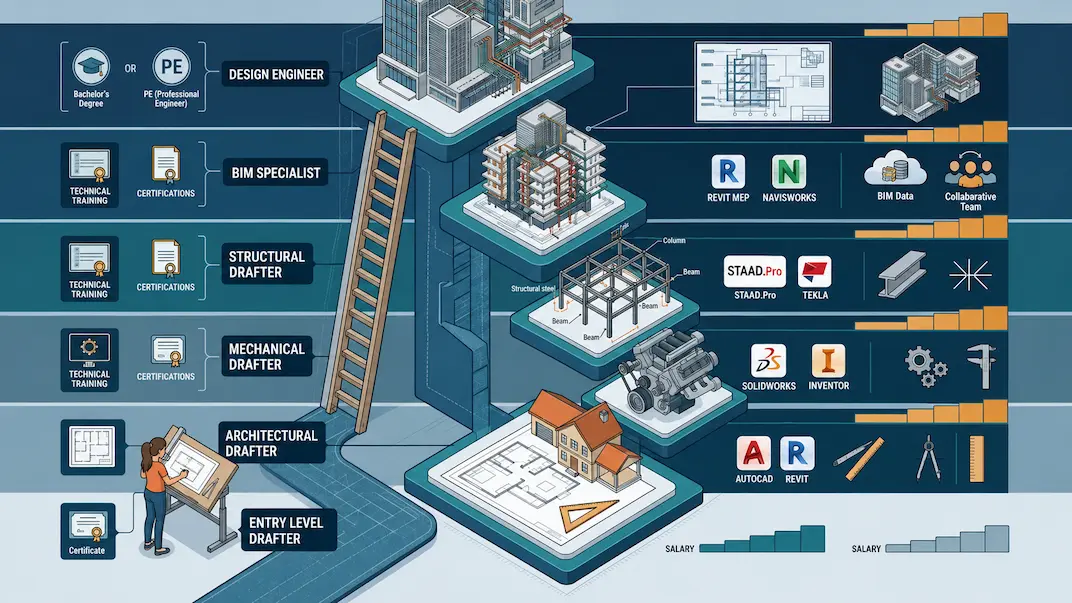
What Is The Salary Range For CAD Drafters?
|
Role Title |
Average Annual Salary |
Experience |
Additional Notes |
| CAD Drafter (National Average) | $53,000–$68,000 | Entry to Mid-level | Roughly $28–$33/hour, with clear room to climb |
| Architectural Drafter | $48,000–$58,000 | 2–5 years | Tends to sit lower than mechanical or electrical roles |
| Mechanical Drafter | $60,000–$70,000 | 5–7 years | Pays more due to technical specialization |
| Structural Drafter (Entry level) | $38,000–$46,000 | 0–2 years | Starting pay is modest but grows quickly with certifications |
| Senior/BIM Specialist | $70,000–$100,000+ | 8+ years | Top pay goes to those skilled in BIM and 3D modeling |
What Affects This Salary Range the Most?
Location is the driving factor that greatly affects the salary of a CAD drafter. Generally, major metro areas with high living costs pay more, but these days smaller markets tied to booming industries can surprise you too. In addition to this, regions with active construction projects and manufacturing sectors often offer a good package to attract skilled drafters. And sometimes they offer extra perks, such as relocation support, rent allowance, and more.
Is CAD Drafting A Stable Job?
Yes, CAD drafting is a stable job. The technical precision and human judgement requirements make it hard to fully replace the person. As long as the construction and manufacturing industries demand detailed technical plans, drafters with technical expertise will keep finding steady work in the industry.
Is there Any Particular Degree Required to Become a CAD Drafter?
If you are thinking that to become a CAD drafter, you need to go back to school to earn a specialized degree. That’s not true. This profession doesn’t require a four-year degree. You can start your career in the drafting field with a postsecondary course or an associate degree in drafting.
Look at the table where we mentioned some education path and their role for advancement in the drafting field.
| Education Path | Typical Duration | What It Covers | Best For |
| High School Diploma + Drafting Electives | N/A | Basic math, computer graphics, intro to design | Building a foundation before further training |
| Certificate/Diploma Program | 6 months – 1 year | CAD software basics, technical drawing fundamentals | Fastest entry into the field |
| Associate Degree in Drafting | 2 years | CAD software and design fundamentals | Most common path; balances speed with depth |
| Bachelor’s Degree (Optional) | 4 years | Broader engineering/design theory, advanced CAD & BIM | Those aiming for senior design or engineering roles later |
| Industry Certifications (e.g., Autodesk, ADDA) | Weeks – a few months | Software-specific or specialty skills | Boosting employability alongside a degree/certificate |
Growth and Specializations in CAD Drafting Field
Choosing CAD drafting as your career means a field that offers you tremendous opportunities to grow. If you are starting your career from an entry-level position, then with learning technical expertise, you can be promoted to a leadership role over time. The overall path of this career is not rigid; it bends toward whichever skill set you decide to develop.
The Entry Level Drafter
Every drafter starts their career from the entry level. They will spend most of their time in translating complex ideas from architects and engineers into precise technical drawings. At this early stage, drafters only focus on mastering the fundamentals. These fundamentals include software proficiency, drawing conventions, and attention to detail. We can say that this entry-level stage is important for building a drafting foundation.
Start Your CAD Drafting Career Today!
CAD Designer, Team Lead, and Manager
Experienced drafters move into designer-level roles where specialisation starts to matter. For instance, picking up BIM modeling often opens doors to CAD Manager or Project Manager positions. These experts know how to combine technical oversight with team coordination. Thus, increasing use of CAD and BIM technology is reshaping the fields and shifting CAD drafting design work toward advanced software skills.
Have a look at some CAD professionals who are usually promoted from entry-level positions.
|
Specialisation |
Focus Area |
Typical Industries |
| Architectural Drafting | Floor plans, elevations, building structures | Residential, commercial, industrial construction |
| Mechanical Drafting | Machinery, tools, equipment design | Manufacturing, product design |
| Civil Drafting | Roads, bridges, infrastructure | Construction, government, land development |
| Electrical/MEP Drafting | Wiring, lighting, plumbing layouts | Large-scale construction, renovation projects |
Beyond the Drafting Table
The next and most advanced step in the CAD drafting field is Design Engineer for those aiming higher. Professionals use CAD know-how as the foundation rather than the whole job at this level. These roles demand budget management and client communication.
Key Skills Required to Become a CAD Drafter
A great CAD drafter is someone who knows how to blend technical precision with transferable skills. Here is a list of all skills required to become a successful CAD drafter
● Software Proficiency
Software proficiency is the key to becoming a CAD Drafter expert. If you want to succeed in this field, you must know advanced tools inside out. The greater your command of these platforms the more accurate your drawings will be.
● Attention to Detail
A single miscalculation can throw off your entire project. That is why it is important to develop a strong habit of double-checking all measurements to become a professional drafter. This attention to detail ensures that every prepared drawing is up to the mark.
● Technical Drawing Knowledge
Understanding the drawing conventions is what separates a buildable drawing from a confusing one. This technical knowledge usually comes from formal training or mentorship at the early stage of your construction project.
● Mathematical Skills
Mathematical skills are the crux for a CAD drafter. During the entire designing and drafting process, the drafting professional needs to use basic geometry, trigonometry, and measurement conversions. You don’t need to be a math expert, but you must be familiar with numbers and arithmetic operations.
● Communication Skills
Drafting is not an isolated profession, and drafters rarely work in isolation. Asking questions to translate an engineer’s idea into a clear drawing and then getting feedback is the core responsibility of a drafter. So, the project communication skills of a drafter must be strong enough.
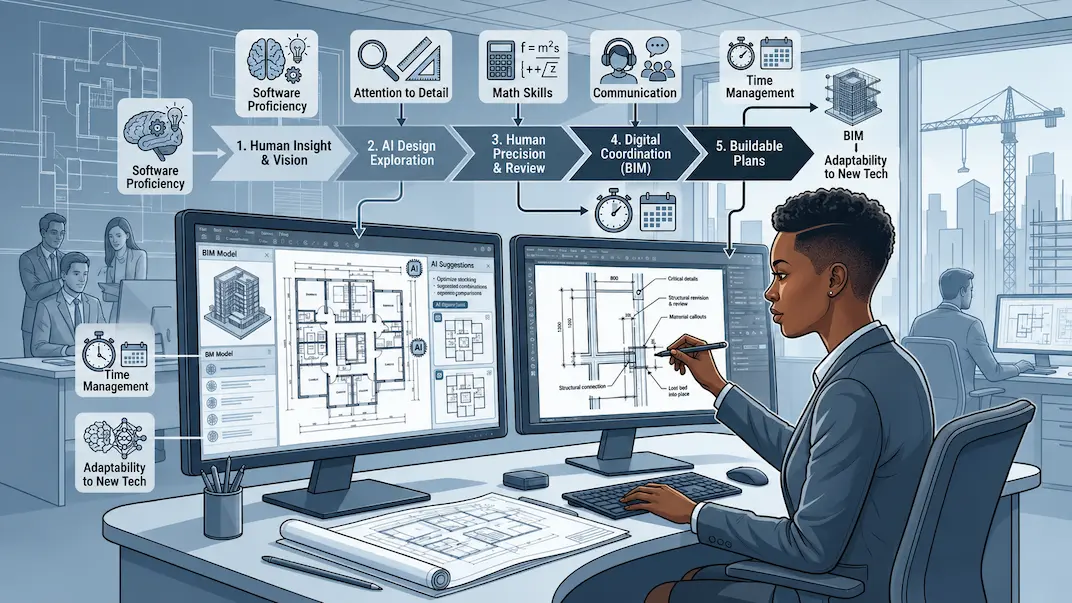
● Effective Time Management
In the construction field, meeting tight deadlines is a hard nut to crack. Therefore, it is important for drafters to learn effective time management skills so that they can prioritize tasks and work efficiently under pressure without missing deadlines.
● Adaptability to New Technology
In the drafting field, a new tool has been introduced each day. So, it is essential for drafters to stay flexible and learn new technology so their skill set stays relevant to the industry.
Conclusion
CAD drafting is a promising career in 2026 for those professionals who have the right technical skills and passion to learn new technologies. With the introduction of AI, there are even more options for drafters to specialize and grow to higher-level roles.
Moreover, the drafting field gives opportunities to entry-level professionals to get promoted to higher roles by acquiring the right expertise and experience. Thus, if you are someone who enjoys turning ideas into buildable designs, CAD drafting is a smart choice for your career.
FAQs
What is the future outlook for CAD drafters?
Despite the limited global employment growth rate, on average, 16,200 job openings for CAD drafters are projected each year over the decade. Most of these job openings are due to replace workers who transfer to different occupations or exit the labor force. No matter what the reason for this higher job opening rate, it is clear that CAD drafting is a fruitful career.
Is learning AutoCAD beneficial in 2026?
AutoCAD is an essential industry-standard design and drafting tool. And it is considered the benchmark for excellence in the drafting field. Whether you are an architect or project manager, AutoCAD is your go-to platform for all design needs for your construction project.
Will AI replace CAD drafting jobs?
AI has rooted itself deeply in the CAD drafting field, but it cannot end CAD drafting jobs. It is the beginning of a hybrid workflow in the drafting sector where software performs repetitive tasks, and humans bring judgment and accountability to these tasks. In other words, we can say that AI has made things easier but cannot replace the whole career.
Is CAD drafting a stable career?
Yes, drafting is a stable career. Every time an engineer or architect designs a new building or part, they need an expert drafter to create exact digital blueprints. As the construction industry is booming, skilled drafters will always be needed.
Is CAD a stressful job?
Generally, CAD is not a stressful job. But the working setup, such as night shift internships, can be stressful due to tight deadlines, precision requirements, and attention to detail. Moreover, stress level also depends on the workload, experience, and environment. It is important to develop strong technical skills to manage this stress.