How CAD Drafting Design Ideas Become Ready for Review
A Drafter in Ohio once told me the worst phone calls never come during a project. They come three weeks after handoff, when a contractor finds a wall that does not match the section view. That single sentence explains why CAD drafting exists, and why it keeps getting harder to do well as projects move faster.
Here is the uncomfortable truth most agencies will not say out loud: a flawless drawing can still sink a project. Not because the geometry was wrong. Because nobody outside the drafting team could actually picture what it meant. Dimensions on a page are a private language. Clients, investors, and buyers do not speak it fluently, and they should not have to.
The Sketch-to-Build Pipeline
Every product or building starts the same way: a napkin idea, a conversation, a rough proportion in someone’s head. Then it has to survive translation. Translation is where most cost overruns are quietly born.
Stage one is the concept brief. It is loose, verbal, and full of assumptions nobody has tested yet. Stage two is the CAD drawing, where assumptions get forced into numbers. Stage three is the 3D model, where those numbers finally take on shape. Stage four, the one team skips when budgets get tight, is the visual asset that lets a non-technical decision-maker say yes with confidence.
Skip stage four, and you are asking a buyer to approve a kitchen renovation from a plumbing schematic. It happens more often than anyone in this industry wants to admit.
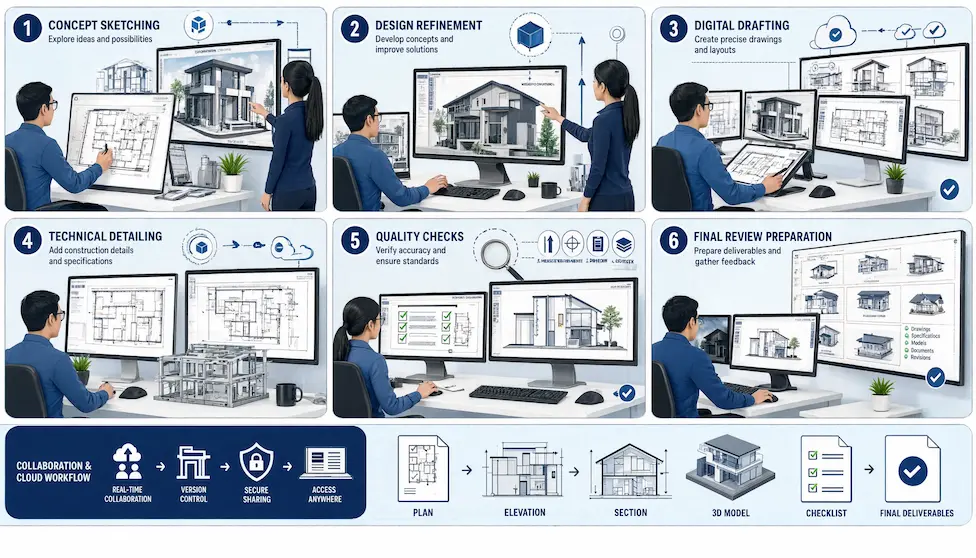
Here’s What CAD Drafting Is Actually Built to Solve
That is the whole job, distilled to one word. Tolerances, sections, elevations, hardware callouts, material specs- every line exists to remove a question before it gets asked on a job site.
At CAD Drafter, we treat ambiguity as a defect, not a stylistic choice. A drawing that leaves room for interpretation is a drawing that will get interpreted three different ways by three different trades, and someone always ends up paying for that mismatch later.
This is skilled, unglamorous work. It rewards people who can anticipate a question the fabricator hasn’t asked yet and answer it inside the drawing before the part ever gets cut. It is also, frankly, not a format built for persuasion. Nobody falls in love with a section view, and nobody should expect to.
Post Approval Status Of CAD Models
Most of what happens to a design after approval depends on imagery, not blueprints. A short list of where that matters most:
- Client and stakeholder sign-off, where the only real question is: is this what we agreed on?
- Catalog and e-commerce photography, generated from one approved model with consistent lighting across an entire product line.
- Investor decks, which often need to make a case before a single physical sample exists.
- Product launches and marketing pushes that need finished-looking assets weeks ahead of the first production run.
There is also a scheduling advantage that gets undersold constantly. Visualization work can start the moment the CAD model is locked. It runs in parallel with tooling and production instead of waiting on a photographer and a physical prototype that does not exist yet.
3D Modeling Is Where the Design Starts Arguing With Itself
Move into three dimensions, and conflicts that hid quietly inside flat drawings suddenly announce themselves. A duct that looked fine in elevation collides with a beam. A drawer that read as spacious on paper turns out to clip the handle of the one beside it.
This is the stage we lean on hardest for internal design review, because geometry does not lie the way assumptions do. Assembly logic gets checked against the actual model instead of being inferred from a stack of separate sheets. Proportions get judged the way they will actually be experienced, not the way they look compressed into an orthographic view.
For furniture and product clients specifically, this is usually where the real decisions get made. Everything before this point was provisional. The 3D model is where provisional becomes committed.
Why Accuracy and Persuasion Are Not the Same Skill
Here is the part agencies rarely explain clearly: a technically perfect model can still be a terrible sales tool. Default gray materials. Flat studio lighting. No context, no scale reference, nothing for a viewer to relate to. The geometry is correct, and the image still fails its only job.
That gap is exactly where product visualization earns its keep. Once a design is locked through CAD Shop drawings and an approved 3D model, specialist studios such as https://cgifurniture.com/ step in and turn that approved geometry into photorealistic renders, lifestyle scenes, and AR-ready visual assets. The underlying shape never changes during this stage. What gets added is everything a non-technical viewer actually needs: believable materials, real-feeling light, and a sense of true scale.
Neither format replaces the other, and pretending otherwise is where projects go sideways. Nobody should manufacture from a lifestyle render. And nobody should ask a client to approve a finish decision from a model still wearing placeholder textures.
Ready to Win More Projects? Contact Our Experts Now!
Furniture Is the Clearest Example of Why You Need Both
Take a chair. The production side needs joinery detail, exact dimensions, upholstery specs, and hardware callouts, full CAD documentation, no shortcuts allowed. The commercial side needs an image where the grain reads correctly, the fabric looks touchable, and the piece sits convincingly in a room at real scale.
A company with only the technical layer cannot manufacture consistently across batches. A company with only the visual layer cannot prove the piece will actually hold together. Both layers, working in tandem, are what let a furniture brand scale past its first hundred units.
Swap furniture for lighting, fixtures, appliances, or architectural millwork. How CAD Drafting Design Ideas Become Ready for Review, and the logic holds steady. The technical layer makes a thing buildable. The visual layer makes it sellable. Treat them as one continuous workflow, and rework drops sharply.
Matching the Format For CAD Models
Confusion usually starts with a mismatch: using a render where a dimensioned drawing was actually required, or asking a buyer to sign off on a finish from a model that was never meant to face a client. A quick reference keeps that straight.
| Need | Best format |
| Exact measurements for a contractor | 2D CAD drawing |
| Manufacturing or construction detailing | Technical working drawing |
| Checking shape, volume, and proportion | 3D CAD model |
| Internal design review before sign-off | 3D model paired with annotated drawings |
| Client or investor presentation | Photorealistic render |
| Catalogue or e-commerce listing | Product render |
| Showing how a product opens, folds, or assembles | 3D animation |
| Letting a buyer explore the piece independently | AR-ready model or 360° view |
Why So Many CAD Projects Quietly Run Over Budget
Rework rarely announces itself as rework. It shows up disguised as a revision request, a clarifying email, a Friday-afternoon call asking why the cabinet hardware in the render does not match the spec sheet. Each of these costs an hour. None of them feels like a crisis on its own.
Add them up across a six-month project and you get something closer to a second project, run invisibly underneath the first one. The root cause is almost always the same: drafting, modeling, and visualization operating as three disconnected vendors instead of one continuous pipeline.
When a drawing gets revised, does the model update automatically? When the model changes, does whoever built the marketing render even find out? In most outsourced workflows, the answer is no, and that gap is exactly where money leaks.
How CAD Drafter Approaches the Handoff
Our process starts where most drafting firms stop: with the question of who has to read this drawing next, and what they will actually do with it. A structural engineer needs different annotation than a millwork shop. A millwork shop needs different annotation than a homeowner trying to picture their own kitchen.
We build every CAD drawing assuming it will eventually need to talk to a 3D model, and we build every model assuming it may eventually need to talk to a visualization team. That assumption alone removes a surprising amount of friction later, because nobody is reverse-engineering someone else’s shortcuts six weeks into the project.
For clients running furniture lines, retail fixtures, or architectural millwork, that connected approach is the difference between a render that matches the shipped product and a render that quietly becomes a liability the moment a customer compares the two.

Choosing Between an In-House Team and an Outsourced Drafting Partner
Hiring a full-time expert is not a small line item. Salary, software licenses and ongoing training on whichever release of the platform your firm standardizes on, it adds up well before the first drawing ships. For firms with steady, predictable volume, that cost makes sense. For firms whose drafting needs swing wildly month to month, it rarely does.
This is the calculation that has pushed so many architecture, furniture, and product firms toward outsourced drafting over the past few years. You get senior-level output without carrying a senior-level salary through the slow months. The trade-off is real, though: outsourcing only works if the partner treats your drawings the way an in-house hire would.
That continuity is something we built in CAD Drafter from day one. Every project gets a consistent point of contact, every revision gets logged against the same source file, and every drawing gets built with the next stage of the pipeline already in mind, whether that next stage is a fabricator’s shop floor or a visualization team putting together a launch campaign.
FAQ
Does a 3D model replace a CAD drawing?
No. A model shows shape and volume. Only a dimensioned drawing carries the tolerances a fabricator is legally and practically bound to follow.
Can I skip straight to renders for an investor pitch?
Only if the underlying geometry is already locked. A render built on an unapproved model is a promise you may not be able to keep.
How long does the full pipeline take?
It depends entirely on complexity, but projects that treat drafting, modeling, and visualization as one workflow consistently move faster than projects that treat them as three separate vendors.
The Bottom Line
CAD drafting and product visualization are not competing services. They are not even adjacent services. On the contrary, they are two halves of one obligation: make the design buildable, and make it understandable. Skip either half, and the other one ends up doing a job it was never built for.
The drawing makes a design precise enough to manufacture. The visual makes it clear enough to approve, present, and sell. Projects move fastest, and budgets stay intact, when each format is doing exactly the job it was built for. There is nothing more and nothing borrowed from the next stage in line.
That is the philosophy behind every project CAD Drafter takes on, whether the deliverable is a dimensioned set headed to a fabrication shop or a model handed off for the kind of polished visualization that closes a sale before the first unit ever leaves the factory.