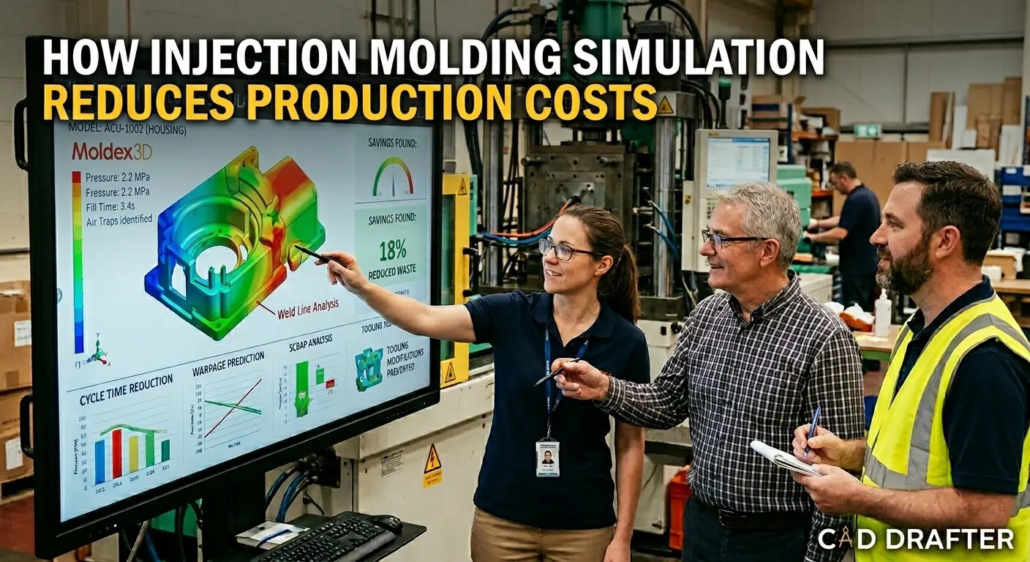
How Injection Molding Simulation Reduces Production Costs
In product development, every single CAD line you draw dictates real-world consequences. This includes cycle times, material usage and the final, tangible quality of the part sitting in your customer’s hands. Injection molding is an absolute powerhouse of a manufacturing process. Until it isn’t.
When do things go wrong? Usually, way too late. For companies leveraging plastic injection molding simulation, the game changes entirely. You get a crystal ball, and you predict production behavior long before anyone signs a purchase order for a massively expensive steel mold.
Think about the compounding effects. Engineering teams avoid useless, cyclical corrections. Total production costs plummet. Because if quality issues rear their ugly heads after the mold is already cut, you are looking at costly mold rework, endless sampling rounds, agonizing development delays, and mountains of wasted resin.
Injection Modeling Simulation stops this dead in its tracks. No more crossing your fingers during physical trials! Engineers can digitally watch molten plastic fill the cavity. They monitor pressure spikes, track cooling rates, and pinpoint exactly where deformation will strike.
The True Cost Drivers in Injection Molding
The upfront price of the mold is just the entry fee. True injection molding costs bleed out through a dozen different technical and production factors. Fail to optimize even one, and your cost-per-part goes through the roof.
if its bad cooling, your cycle time just doubled. The wrong gate location opens every way for filling issues and ugly surface defects that demand immediate tooling changes. Let’s break down the real financial leaks:
| Cost Driver | The Hidden Risk if Ignored | The Financial Impact |
| Mold Design & Tooling | Reworking steel after the first physical sampling. | Huge project delays; expensive secondary machining fees. |
| Material & Scrap | High rejection rates; excessive wasted resin. | Direct and immediate profit margin erosion. |
| Cycle Time | Unnecessary seconds added to every single part. | Lower factory throughput, higher operational overhead. |
| Clamping Force | Specifying a much larger machine than actually needed. | Paying premium hourly rates for oversized equipment. |
| Cooling Efficiency | Uneven part shrinkage; extended cooling cycles. | Warped parts; plummeting quality yield rates. |
Why Cutting Steel Should Be Your Absolute Last Step
Cutting steel is expensive, but adding plastic is cheap. The mold itself easily eats up the lion’s share of your project budget. Once that tool is machined, changes aren’t just complicated; they are brutal.
Need a minor tweak to a gate? A slight adjustment to the runners or cooling channels? You are looking at fresh machining operations, immediate project delays, and a very unhappy finance department.
Simulation aggressively mitigates this risk. It serves as a digital proving ground. You validate the CAD design well before the toolmaker touches a block of metal. Test wildly different scenarios. Fail virtually. Succeed physically. You can confidently choose the absolute most efficient tooling option while it’s still just pixels on a screen.
Gate Location Optimization Is The Make-or-Break Decision
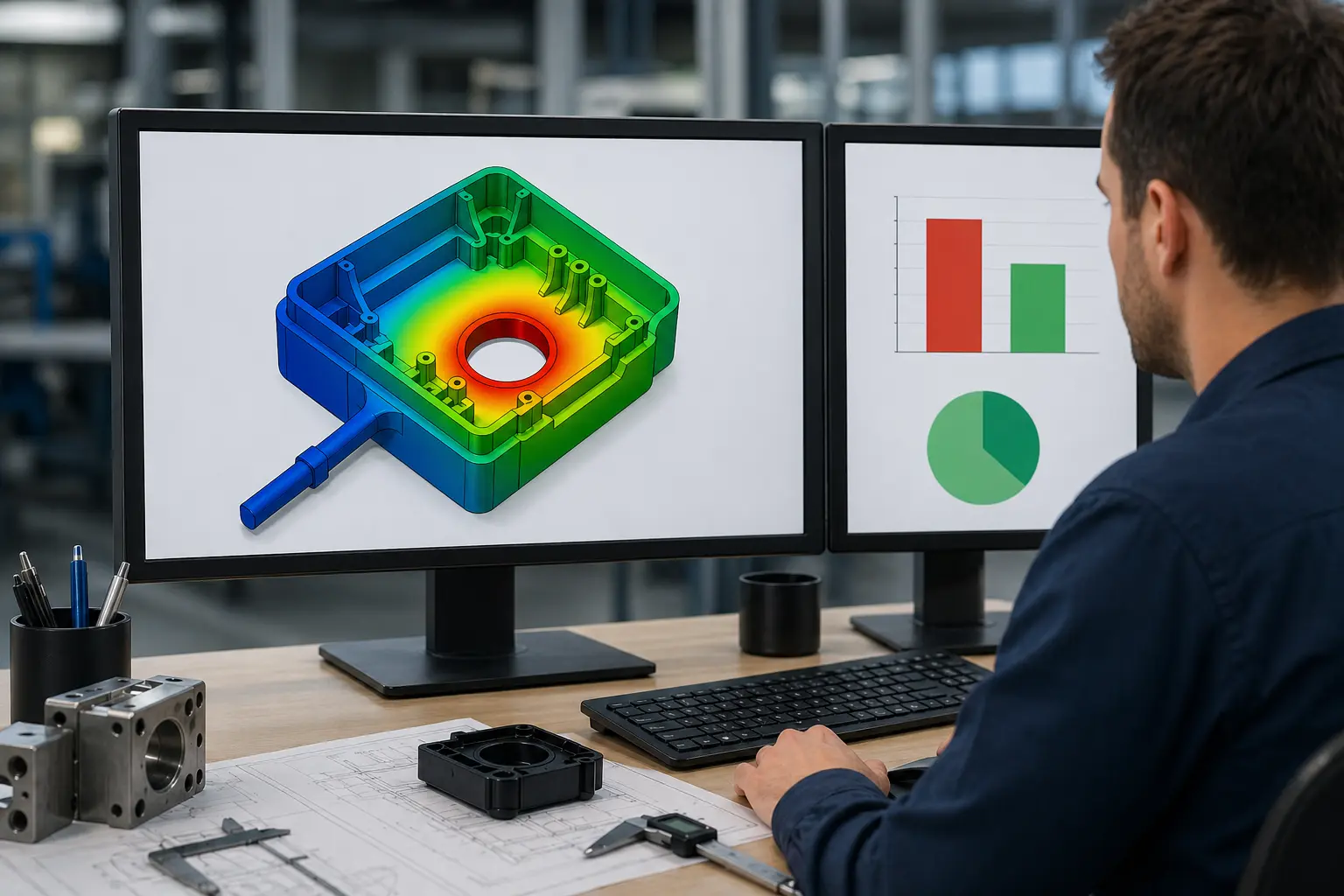
Gate location dictates everything. It controls exactly how molten plastic surges into the cavity. Getting it wrong will lead towards errors in weld lines, air traps, pressure spikes, and nasty cosmetic blemishes on the final product.
Simulation takes the dangerous guesswork out of gating. It maps out the harsh reality of the flow.
Here is exactly what the simulation exposes before you build:
- Melt Front Kinematics: Watch exactly how the material pushes through the complex part geometry.
- Pressure Heatmaps: Pinpoint precisely where pressure dangerously spikes during the filling phase.
- Defect Prediction: Identify the exact coordinates where weak weld lines or trapped air will naturally form.
- Fill Uniformity: Confirm if the cavity fills evenly, or if you are risking a short shot.
Nail the gate position in the CAD phase, and you practically eliminate the need for post-production tool butchering.
Runner and Feeding System Balancing
Running a multi-cavity mold? Dealing with a highly complex, asymmetrical part? Your feeding system needs to be flawlessly balanced. There is zero margin for error here.
If cavity A fills even a fraction of a second faster than cavity B, you are setting yourself up for a nightmare. We are talking inconsistent part quality, severe overpacking in one zone, short shots in another, and wild dimensional variations across the board.
This is where simulation flexes its analytical muscles. Engineers can seamlessly swap between cold runner and hot runner concepts. They can run flow balance analytics. They can hunt down and eliminate unnecessary pressure drops across the manifold. The result? A remarkably stable manufacturing process and a drastic reduction in the pile of rejected parts sitting next to the molding machine.
CAD Drafting Services and Simulation
Outstanding CAD drafting isn’t just about creating a visually appealing 3D model. It’s about creating a manufacturable one. When CAD drafting services integrate injection molding simulation early in the design phase, the entire trajectory of the project shifts.
You stop passing unverified concepts over the wall to manufacturing. Instead, your CAD models become robust, production-ready assets. This synergy between precise drafting and predictive simulation is what separates amateur design from professional engineering.
Get Specialized CAD Services From Our Team!
Reducing Material Waste to Zero (Or Dangerously Close to It)
Material waste is the silent, creeping killer of injection molding profit margins. Scrap doesn’t just spontaneously happen on the shop floor. It is engineered by mistake and stems from severe overpacking, bloated runners, and wildly unstable process settings. Also, it is caused by a poorly designed wall thickness that nobody bothered to verify in the CAD software.
Simulation stops the financial bleeding. It flags weak points before the material hopper is even loaded. Engineers can tweak wall thickness. They dial in the packing pressure and completely re-engineer the filling behavior.
You may ask Why? The only reason is to guarantee defective parts never see the light of day.
Look at the usual suspects simulation helps you avoid:
- Sink marks lurking dangerously near overly thick part sections.
- Short shots resulting from lazy, unoptimized filling paths.
- Burn marks caused by trapped, superheated air in blind corners.
- Warpage that aggressively bends your parts out of tolerance.
- Shrinkage that ruins your dimensional accuracy and assembly fit.
When you drastically slash the defect rate, material usage finally becomes predictable. Try running an unoptimized mold with an expensive carbon-fiber-reinforced polymer. Your accountant will weep. Simulation protects that heavy material investment.
Dialing in Process Parameters Before Production Starts
Simulation isn’t just a toy for the CAD drafting department but an absolute cheat code for the process engineers out on the factory floor.
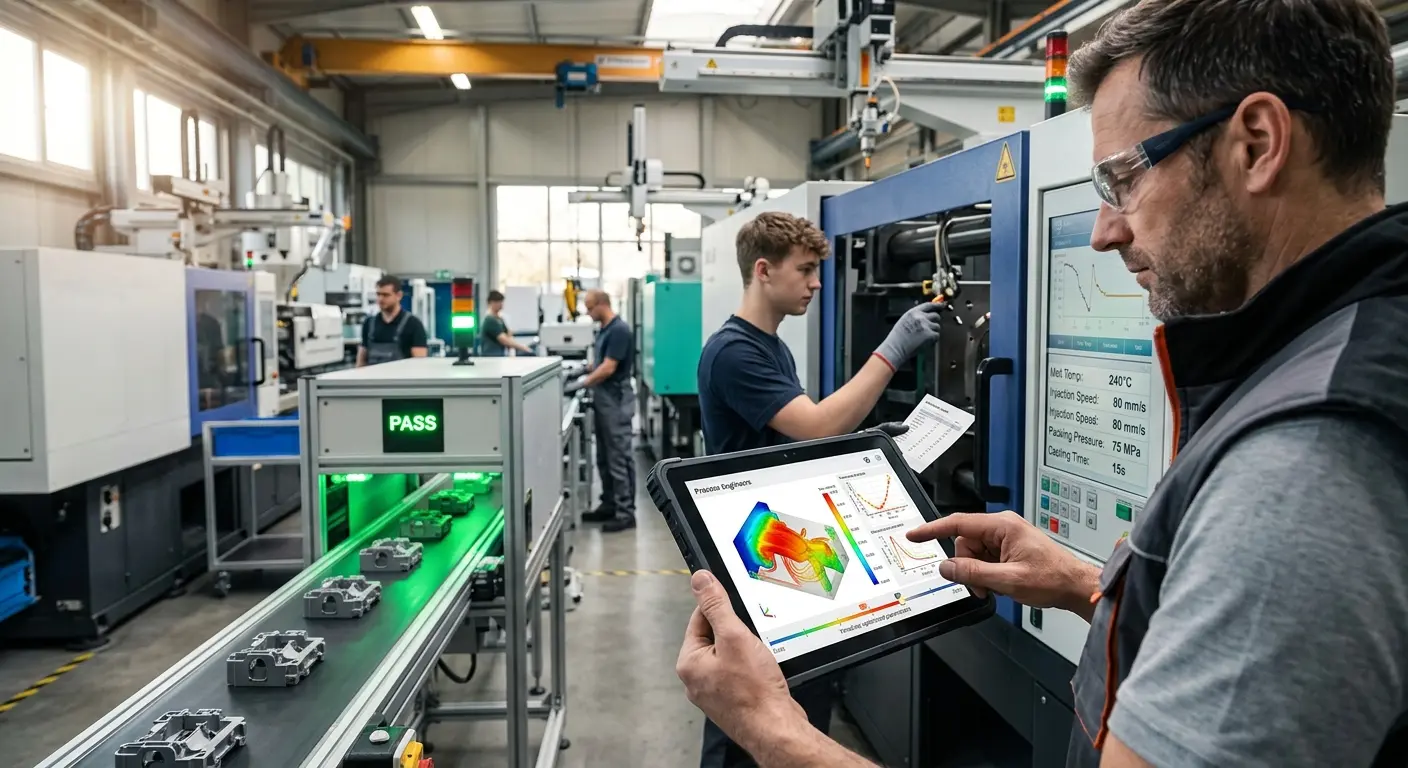
It optimizes crucial machine parameters before the very first physical trial. This hands manufacturers a rock-solid starting point. Say a permanent goodbye to the dark ages of trial-and-error knob turning at the machine panel. What exact parameters are we locking down early?
- Melt and Mold Temperatures: Getting the complex thermal dynamics absolutely perfect.
- Injection Speed: Balancing plastic flow without causing shear degradation.
- Packing Pressure: Preventing internal voids without accidentally flashing the tool.
- Cooling Time: Shaving precious seconds off the cycle without warping the part upon ejection.
When these dials are set right from day one, pure magic happens. The process stabilizes immediately. Machine time suddenly frees up. Massive energy bills drop. And you skip the agonizing cycle of repeated sampling and constant, panicked tool adjustments.
Where BIM Modeling for Construction Enters the Picture
Wait, how does this connect to BIM modeling for construction? It’s simpler than you think.
Modern commercial buildings rely heavily on incredibly complex plastic components. Intricate HVAC diffusers. Highly specialized plumbing fittings. Heavy-duty electrical housings. Custom structural mounting brackets.
When BIM modelers specify these exact parts in their 3D environments, they need absolute certainty. Injection molding simulation ensures these critical construction components can actually be manufactured at a massive scale. It permanently bridges the gap between the building plan and the factory floor.
The architect gets the exact geometry they demanded in the BIM model. The manufacturer gets a plastic part that is incredibly profitable to mold. Everyone wins. No supply chain bottlenecks. No compromised building designs.
Conclusion
Injection molding simulation is an absolute necessity for modern manufacturing. It aggressively destroys hidden production costs, accelerates cycle times, and eliminates defects before they occur. By validating CAD designs virtually, engineering teams remove expensive guesswork and drastically lower tooling risks.
Professional Injection molding simulation translates unpredictable physical trials into guaranteed manufacturing success. Stop guessing, start predicting today, and watch your profit margins rapidly climb.
Frequently Asked Questions
Why is injection molding simulation necessary?
It acts as a digital safety net. By predicting flow, cooling, and warpage virtually, manufacturers avoid extremely expensive mold reworks. It ensures your CAD design is actually manufacturable before cutting any costly steel tooling.
Can simulation really reduce my cycle times?
Absolutely. Simulation allows engineers to optimize cooling channel layouts and thermal management within the mold. Faster, more uniform cooling directly translates to shorter cycle times, significantly boosting your overall factory throughput and daily profitability.
How does gating impact the final plastic part?
Gate location dictates the entire resin flow path. A poor choice causes trapped air, nasty weld lines, and severe cosmetic flaws. Simulation pinpoints the perfect gate location to guarantee a smooth, balanced, and structurally sound fill.
What role does this play in BIM modeling?
Construction heavily relies on custom plastic fittings and electrical housings. Integrating molding simulation ensures the complex components detailed in your BIM models can actually be mass-produced efficiently, keeping construction supply chains moving without costly delays.
Does virtual testing eliminate all physical mold trials?
While it won’t eliminate every single physical trial, it drastically reduces them. You skip the initial, error-prone guessing phases. Your first physical sample will be remarkably close to perfect, saving you immense time and wasted materials.