CAD Drafting Trends In 2026: Design, Collaboration and Innovation
CAD drafting is no longer a matter of lines on a screen in 2026, but is turning into a dynamic battlefield of automation, collaboration, AI, cloud computing, immersive reality, and transforming workflows disruptively.
This paper unpacks the most significant current trends influencing the practice of CAD drafting, and it does not just brush the surface. We plunge into the reasons why the market is changing, the technologies that are driving this change and how designers, engineers, architects and manufacturers are changing.
State of CAD Drafting Today
The international CAD (Computer-Aided Design) software market is still in a healthy growth till 2026. Moreover, it is growing at a consistent pace. The industry research notes that the market would grow by an average of 7 percent in 2026. That is an estimated market value of 21.7 billion.
That expansion is not being incremental through upgrades, but rather is being driven by new processes, new user requirements, and new automation and efficiency requirements. Cloud, artificial intelligence, real-time collaboration, and integrated outputs of manufacturing, such as CAM and simulation, are disrupting legacy drafting.
Within that macro picture:
- Global designs show the majority share of 3D CAD platforms that are in excess of 60 percent.
- The use of cloud-based CAD is increasing fast, and approximately 35-48 percent of designers are using cloud-based tools to support real-time collaboration as remote and distributed teams continue to grow.
- CAD is becoming more interoperable with BIM (which is becoming more of a silo), and cross-discipline design processes are becoming more common.
It is not a niche software trend. It is an industry infrastructure change, which operates via engineering, architecture, construction, manufacturing, automotive, aerospace, product design, and even healthcare equipment.
Artificial Intelligence:
AI is no longer a buzzword in the drafting of CAD. Machine learning and generative AI are no longer considered a nice-to-have feature across CAD platforms, but workflow accelerators:
The automated design of AI is a routine that was previously taking hours to be manually drafted, but now it takes minutes or seconds.
| Important Note |
| In many companies today, AI automates up to 20–30% of routine drafting tasks. |
Tools in generative design are not only being applied in optimization, but also in creative exploration, to generate design iterations that would otherwise be impossible to think of manually by a human designer. The tools have demonstrated an efficiency of 15-30% in design time compared to the conventional methods.
There is the emergence of natural language and conversational AI systems, in which designers can talk or write about a design, and the software converts it into geometry implemented.
What it yields is not the accelerated drafting. On the contrary, it is a rediscovery of the role of the designer. The designers are becoming less specific implementers of technical directions and more advanced design strategists, allowing AI to manage complexity, detail, iteration, and refinement.
But there are caveats. Although AI can speed up less complex tasks, high-complexity and high-precision designs (e.g., complex injection-molded components or high-precision optics) still demand human expertise. The future will not make designers obsolete; it will redefine the subject of interest of expert designers.
2. Cloud and Collaboration: The Drafting Workflow Real-Time Evolution.
Gone are the times of desktop-locked CAD files. The cloud-based CAD solutions are not merely files stored on the internet, but they are changing the way teams work, communicate and develop as a team. Multi-user real-time editing, automatic version controls without duplicates, and real-time time zone access are changing the expectations.
Benefits of Cloud Collaborations
Errors Reduced
Live co-design and real-time review features that reduce traditional bottlenecks and eliminate file check-out/in models.
High Satisfaction Rate
Cloud CAD satisfaction rates are as high as ~80% among users who adopt these tools. That’s because of real-time monitoring, access, and support.
Collaboration is not only the most significant effect of the cloud, but also access. Now designers are able to work on the same model in real time, and find out the changes and solve conflicts without having to have different versions of the file or emails with some attachments. Not that it is peripheral comfort. It is basic productivity boosting.
3. Immersive/ Augmented Experiences: VR/AR Design
Immersive technologies are no longer only useful in showrooms, but are now also being used practically in drafting verification and design validation.
The use of AR and VR in CAD is more of an assembly guidance, whereby digital models are overlaid on the physical equipment during the manufacturing or construction process.
VR walkthroughs allow stakeholders to see designs prior to their creation to enhance decision-making and reduce costly corrections once the construction process has started.
No longer can 2D plans and even the most basic 3D models do any good; now teams are taking virtual reality field trips to walk through buildings, inspect assemblies in lifelike VR, and provide stakeholders with the sense of place that only a 3D environment can bring.
This is not a mere aesthetic immersion; this is a transformational one. In such sectors as architecture and aerospace, they decrease the amount of rework, accelerate approvals, and introduce lay stakeholders into the design discussion with an efficacy that 2D never achieved.
4. Interaction with Manufacturing: CAD + CAM + Simulation
CAD drafting in 2026 isn’t siloed. It is closely bound to the next step of design, which is manufacturing, testing, simulation, and production.
The interrelationships are growing closer:
- CAD combined with CAM (Computer-Aided Manufacturing) minimizes handoffs so that a design can be broken into toolpath generation.
- The ability to see stress, heat maps, and predictions of performance before a part is manufactured is called simulation-embedded CAD. It is common to have simulation tools now reside within the same environment as drafting.
- The iterative improvements in a product or building after launch or construction have been made possible by Digital Twin workflows, where a digital version of a product or a building is used to reflect the actual performance of the product or building.
These integrations are not just a convenient way to be; they are a source of revenue. Simulation and integrated manufacturing have been reported to result in faster time-to-market, lower prototyping, and improved product reliability in companies.
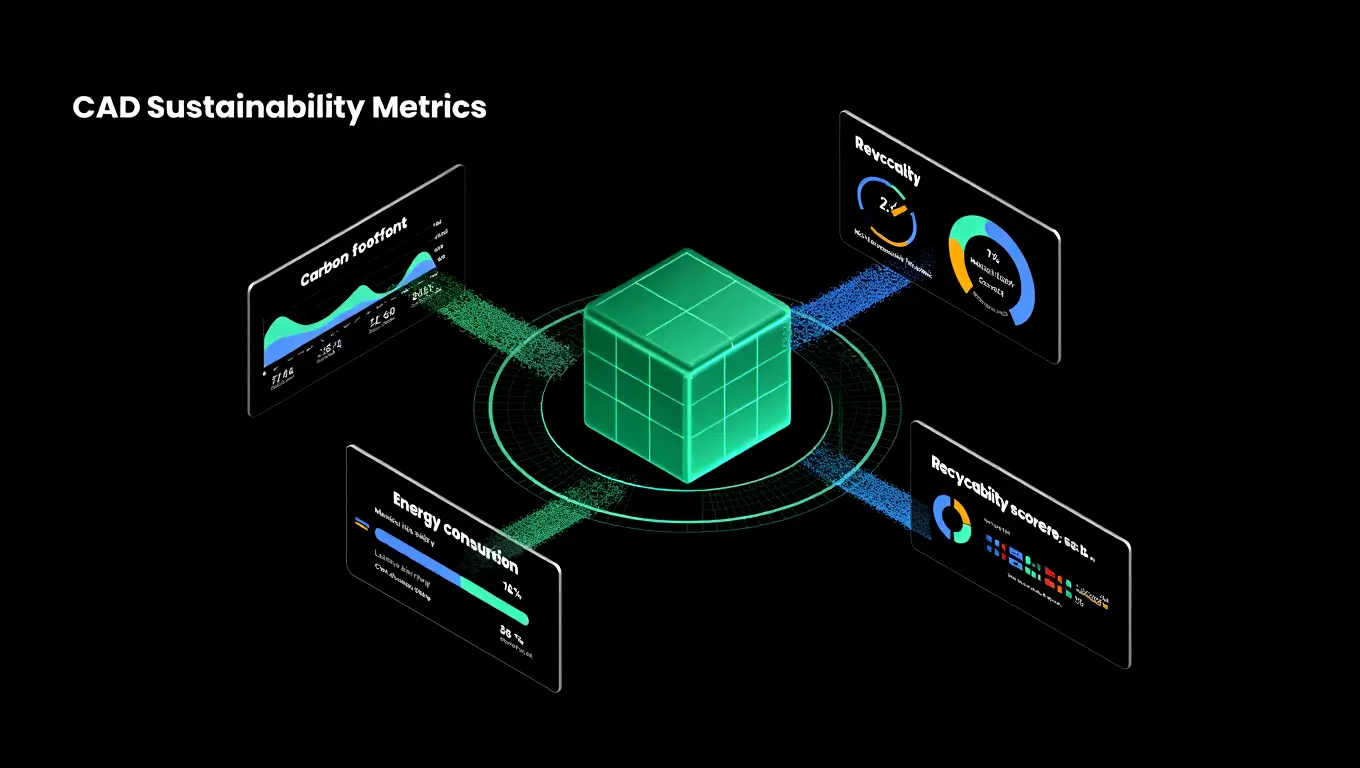
5. Green and Sustainability Metrics in CAD
Sustainability is no longer a feature of an after-sales sale; it is incorporated into CAD workflows. In 2026, designers will be able to assess carbon footprint, energy use, material reuse, and lifecycle effects directly in CADs. It is not an ideological change, but rather a change brought about by market demand and regulation:
- Customers are also requiring environmental performance measures before choosing designs.
- BIM and CAD are converging on the green analysis tools which simulate energy, heat gain and resource use at early design stages.
- On the manufacturing side, topology optimization and material-efficient design minimize waste and cost.
Sustainable design is not merely a trend, but a quantifiable need that is embedded into the structure of drafting tools and outputs.
6. Interoperability, Open Standards & Flexibility of Workflow
Interoperability is one of the most underrated (yet the most important) trends of 2026. Design environments are no longer proprietary silos. The CAD systems, BIM platforms, analysis tools and simulation engines are being made to exchange data without re-entry or construction through open standards such as IFC (Industry Foundation Classes) and modern APIs.
This is important for one reason: design ecosystems are as strong as the weakest link in the chain.
- Reduces repeated work.
- Eradicates the errors of translation.
- Maintains design intent over platforms.
It also speeds up interdisciplinary processes. It implies that all architects and structural engineers, MEP designers, and manufacturers can operate with common and consistent models.
7. The Human Factor: Skills, Learning Curves, and Career Implications
It is not only technology that is changing. The people who use it are too. CAD drafting is taking a new dimension today as a strategic design discipline, where in the past, CAD drafting was a role that was characterized by careful annotation and line work. CAD professionals now have to master:
- AI-augmented workflows.
- Principles of cloud collaboration.
- Simulation interpretation.
- Data-driven optimization.
Combination with manufacturing products.
The skill gap is real. According to industry reports, 42 percent of the potential adopters have indicated cost barriers and skill barriers as impediments to CAD implementation, and 31 percent of the potential adopters have indicated training as a hindrance.
This is indicative of something bigger than technology: CAD drafting is not all about eliminating humans in favor of machines, but about giving humans more power so that they can take advantage of machines.
8. The Grey Future Of The Old-Fashioned Drafting
Although all of this change takes place, not all drafting tasks disappear in 2026.
Interesting Note:
According to multiple industry estimates, 2D drafting still accounts for roughly 28–38% of CAD deployments globally, especially in industries that rely on legacy documentation standards or low-cost entry tools.
Despite the emergence of immersive workflows and 3D modelling, flat drawings are the final mile of communication, interpretable, portable, and yet the agreement between design and fabrication.
In other words:
3D is not substituting 2D at all; it is redefining the way 2D is created, consumed, and connected to more detailed models. The most effective design teams are the hybrid ones, the ones that are fluent in the old and new paradigms.
9. Market Leaders and Software Shifts: Who Will Win in 2026?
The CAD drafting environment is not a monopoly. The major platforms remain innovative and competing, and they have strengths:
- Fusion is already capturing a leading portion of new CAD seats, particularly in the mid-market and startup design teams, due in large part to its built-in cloud-based CAD collaboration, generative design, and end-to-end workflow continuity.
- SolidWorks retains control in the high-precision mechanical design and controlled industries where there is advanced tolerance verification and compliance.
Generative Design Becomes Operational, not Experimental.
Generative design used to be a research lab far-fetched idea a few years back. In 2026, it’s operational. In the present engineering practice, constraint-based algorithms are employed by engineering teams to search through thousands (or even tens of thousands) of geometry variations by load conditions, materials, cost limits, and manufacturing constraints. Engineers specify performance requirements and allow the system to develop candidate solutions rather than illustrate a bracket and test it.
So, what changed?
First, computing power became cheaper and more accessible through cloud infrastructure.
Second, integration with simulation engines improved.
Third, confidence increased because early adopters proved that algorithmically generated geometries could outperform human-conceived ones in weight reduction and structural efficiency.
In the aerospace and automotive sectors, generative optimization has demonstrated weight reductions between 10% and 40% in certain components without sacrificing strength. That is not a marginal improvement. That is fuel savings, emissions reduction, and lower material costs, at scale.
Yet generative design doesn’t replace engineering judgment. It introduces complexity. Some optimized geometries are difficult or expensive to manufacture unless paired with additive manufacturing workflows. Which brings us to another defining shift.
11. Additive Manufacturing Reshapes Drafting Constraints
The rise of industrial 3D printing has quietly influenced how CAD drafting is approached. Traditional subtractive manufacturing required designers to think in terms of tool access, machining angles, and material removal. Additive manufacturing removes many of those constraints, but introduces new ones: lattice optimization, support structure planning, heat distribution modeling.
By 2026, additive manufacturing is no longer niche. Global additive manufacturing markets are projected to surpass $40 billion within the next few years, growing at double-digit annual rates. CAD systems have adapted accordingly.
Modern drafting platforms now include:
- Native lattice generation tools
- Automated support generation
- Print simulation modules
- Material behavior prediction
Design for Manufacturing (DFM) is expanding into Design for Additive Manufacturing (DfAM). Drafting decisions increasingly account for layer orientation, anisotropic material behavior, and post-processing requirements. The implication? Drafting is no longer geometry alone. It is physics-aware, production-aware modeling.
Transform your design process with the latest drafting innovations.
12. Automation of Documentation: The Silent Productivity Multiplier
One of the least glamorous (but most impactful) trends in 2026 CAD drafting is automated documentation. Creating technical drawings, annotations, bill of materials (BOM), dimension tables, and compliance documentation used to consume disproportionate hours. Today, many of those tasks are semi-automated or fully automated.
Rule-based systems can:
- Auto-generate orthographic views
- Apply dimensioning standards automatically
- Flag tolerance conflicts
- Populate material specifications from part libraries
Companies implementing documentation automation report measurable reductions in drafting cycle times. In some cases, drawing preparation time drops by 25–35%.
This doesn’t make documentation irrelevant. It makes it more consistent. Errors decrease. Standards compliance improves. Audit trails become cleaner. For industries like medical devices, defense, and automotive (where compliance is non-negotiable), reliability is invaluable.
13. The Rise of Subscription Economics and Licensing Shifts
Behind the scenes, a business model transformation is shaping how CAD drafting tools are accessed. Perpetual licenses have largely given way to subscription-based models. Vendors prefer predictable recurring revenue. Users gain lower upfront costs but commit to ongoing payments.
The subscription model has implications:
- More frequent updates and feature releases
- Cloud-based storage and integrated services
- Greater vendor dependency
Market data shows that the majority of new CAD licenses issued globally are now subscription-based rather than perpetual. For smaller firms, this lowers entry barriers. For larger enterprises, it introduces long-term budgeting considerations.
It also changes expectations. Users expect continuous improvement, not major upgrades every three years.
Software providers are responding by pushing AI features, collaborative enhancements, and industry-specific toolsets at accelerated release cycles.
14. Data Security & IP Protection Become Central
As CAD workflows move into the cloud, data security moves to the forefront. Engineering files represent intellectual property. In aerospace, defense, medical devices, and proprietary manufacturing, design files are assets worth millions.
By 2026, CAD platforms incorporate:
- End-to-end encryption
- Role-based access controls
- Multi-factor authentication
- Granular version tracking
The cybersecurity market itself continues to grow at double-digit rates, and CAD vendors increasingly integrate enterprise-grade security measures to reassure clients.
The challenge is balance. Teams want frictionless collaboration. They also need strict IP control. The best systems now offer both cloud collaboration and enterprise governance layers.
15. Mobile & Edge Access: Drafting Beyond the Office
Another subtle but important evolution: CAD drafting is no longer desk-bound. Field engineers review models on tablets. Construction managers pull up live models onsite. Manufacturing supervisors check updated assemblies directly from the production floor.
Mobile-optimized CAD viewers and lightweight editing tools are expanding access. While full-scale modeling still benefits from powerful workstations, review and markup capabilities are increasingly device-agnostic.
In construction workflows, especially, this reduces miscommunication between design offices and job sites. When a structural conflict appears, teams can cross-reference the live model instantly.
16. BIM-CAD Convergence: Blurring Boundaries
Architecture and construction have seen a profound blending of CAD drafting and Building Information Modeling (BIM). Where CAD once focused on geometry, BIM incorporates data layers: material properties, cost data, lifecycle metrics, and maintenance schedules.
By 2026, interoperability between CAD and BIM environments will have improved dramatically. Structural engineers, architects, and MEP designers increasingly operate within shared model ecosystems. The global BIM market continues to grow steadily, projected to exceed $15 billion within the coming years. Its expansion directly influences CAD drafting expectations.
Design drawings are no longer static documents. They are data-rich environments linked to cost estimation, scheduling, and facility management systems. For drafters and modelers, that means higher responsibility. Every modeled element carries downstream implications.
17. Outsourcing & Globalization of Drafting Services
Another defining trend: the globalization of CAD drafting services. Remote collaboration tools have enabled firms to outsource drafting tasks to specialized providers across different geographies. This isn’t purely cost-driven. It’s also about capacity flexibility.
Firms can scale drafting resources up or down based on project loads without permanent staffing adjustments.
Outsourcing markets for CAD services continue expanding, particularly in regions with strong technical education infrastructures. Cloud collaboration makes file transfer and coordination seamless.
However, outsourcing demands strong standardization. File naming conventions, template usage, and modeling practices all must align to prevent integration chaos.
The firms succeeding in outsourced CAD partnerships are those that invest in robust workflow documentation and centralized model governance.

18. Sustainability Metrics Move from Marketing to Mandate
We touched earlier on sustainability integration. By 2026, it’s not optional in many sectors. Regulatory pressures (especially in Europe and parts of North America) increasingly require lifecycle assessments and energy performance documentation. CAD systems now interface directly with environmental analysis engines.
Designers can:
- Compare material carbon footprints
- Simulate building energy performance
- Evaluate lifecycle costs
This shift alters design priorities. Efficiency competes with aesthetics and cost. Material selection decisions become data-driven. In manufacturing, lightweighting strategies and material reduction are not just sustainability goals; they are competitive differentiators.
19. The Modern CAD Professional
If you are asking yourself, “Will AI replace CAD drafters?” let us clear the confusion. It will not! Undoubtedly, the profile of a CAD drafter in 2026 looks very different from that of 2010. Technical proficiency remains essential. But it is no longer sufficient. Modern CAD professionals increasingly require:
- Understanding of automation scripting
- Familiarity with AI-assisted workflows
- Knowledge of manufacturing constraints
- Comfort with collaborative cloud systems
Data literacy
Educational institutions are adjusting curricula accordingly. Engineering and drafting programs now incorporate parametric modeling, simulation basics, and digital collaboration frameworks.
The demand for hybrid skill sets (part designer, part analyst, part technologist) continues to grow. And while automation handles repetitive detailing, the demand for high-level problem solvers intensifies.
What Hasn’t Changed
Amid rapid transformation, some fundamentals endure. Precision still matters, tolerances still matter, and clear communication still matters.
Even with immersive visualization and AI-assisted drafting, final outputs must meet exacting standards. Manufacturing floors still depend on clarity. Contractors still rely on unambiguous documentation. Technology evolves, but the obligation to accuracy does not.
The Strategic Outlook for 2027 and Beyond
If 2026 feels transitional, because it is! Several trajectories appear likely to accelerate:
- AI systems are becoming more context-aware, learning company-specific standards and preferences.
- Greater integration between CAD and supply chain data.
- Expanded digital twin ecosystems linking design directly to operational analytics.
- Increased regulatory integration, embedding compliance checks directly into drafting environments.
CAD drafting is becoming an intelligent node in a larger digital infrastructure. Not a drawing tool. A decision engine.
Frequently Asked Questions (FAQs)
1. What are the biggest CAD drafting trends in 2026?
The biggest CAD drafting trends in 2026 include AI-assisted design automation, cloud-based collaboration platforms, generative design workflows, BIM-CAD convergence, additive manufacturing integration, and real-time simulation.
2. How is artificial intelligence changing CAD drafting?
AI is automating repetitive drafting tasks such as dimensioning, documentation, tolerance validation, and part optimization. In many firms, AI now handles up to 20–30% of routine drafting activities. Generative design algorithms allow engineers to define constraints and let the system produce optimized geometry variations.
3. Is 2D drafting becoming obsolete in 2026?
No. While 3D modeling dominates modern workflows, 2D drafting remains essential for manufacturing documentation, construction drawings, and regulatory submissions. Approximately 30% of global CAD workflows still rely on 2D drafting, particularly in legacy systems and cost-sensitive industries.
4. What role does cloud computing play in modern CAD drafting?
Cloud computing enables real-time collaboration, centralized file management, automatic version control, and remote access. Designers across different locations can work simultaneously on the same model.
5. How does CAD integrate with manufacturing in 2026?
Modern CAD systems integrate directly with CAM (Computer-Aided Manufacturing), simulation tools, and additive manufacturing platforms. Designers can simulate stress, thermal loads, and production constraints before fabrication. This integration reduces errors, shortens product development cycles, and minimizes prototyping costs.
6. What skills are required for CAD professionals in 2026?
Essential skills include parametric modeling, AI-assisted design workflows, simulation interpretation, cloud collaboration, automation scripting, data literacy, and an understanding of manufacturing processes.
7. How is sustainability influencing CAD drafting?
Sustainability is embedded directly into modern CAD tools. Designers can analyze material carbon footprints, simulate building energy performance, and assess lifecycle costs during early design phases.
8. Are subscription-based CAD licenses better than perpetual licenses?
Subscription models lower upfront costs and provide continuous updates, cloud storage, and integrated services. However, they create long-term recurring expenses and vendor dependency.
9. How secure are cloud-based CAD platforms?
Leading CAD platforms now incorporate enterprise-grade security, including end-to-end encryption, multi-factor authentication, role-based access control, and version tracking. For industries handling sensitive intellectual property, vendors have strengthened compliance frameworks to meet global cybersecurity standards.
10. What is the future outlook for CAD drafting beyond 2026?
The future points toward deeper AI integration, fully connected digital twin ecosystems, automated compliance verification, and tighter integration between design, supply chain, and operational data.
Conclusion:
The CAD drafting landscape in 2026 is defined less by incremental feature upgrades and more by systemic transformation. This includes artificial intelligence that augments design and cloud platforms that dissolve geographic barriers. And through all of it, the role of the designer evolves (not disappearing, but ascending).
All trends listed above can help improve CAD drafting and take the fabrication of construction components to the next level. Learn more about the relationship between AI and CAD in our related guides.