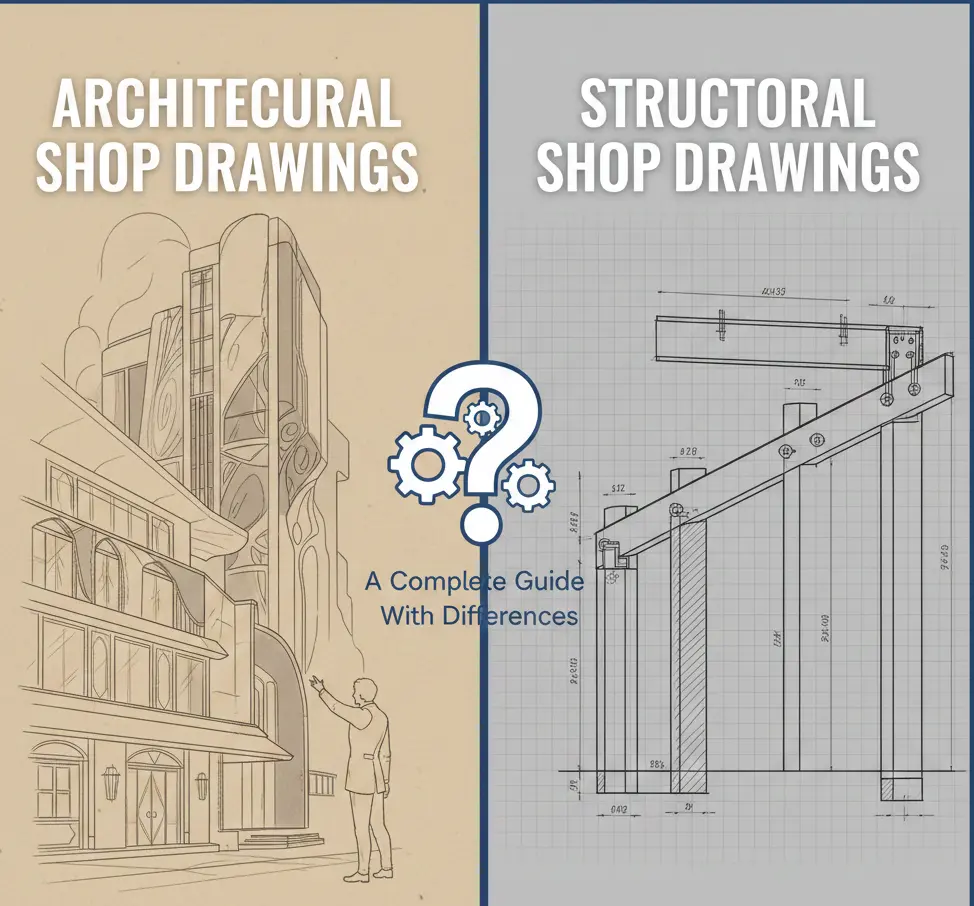
Architectural Vs Structural Shop Drawings: A Complete Guide With Differences
Design intent is a dream, and shop drawings are the alarm clock. In the evolution of a building, transforming from a flickering 2D CAD file into a tangible mass of steel and glass, the most vital documents aren’t the glossy renderings shown to investors. They are the shop drawings.
Think of design drawings as the suggestion and shop drawings as the command. They represent the manufacturer’s rigorous translation of an architect’s vision into actionable instructions for the CNC machine, the welder, and the field crew. But here lies the rub.
A volatile friction exists between Architectural Shop Drawings and Structural Shop Drawings. When these two parallel universes fail to align, the consequences are more than just inconvenient! They are financially and physically catastrophic. Imagine a massive W-beam slicing through an ornamental glass facade, or a floor slab poured so thick that the HVAC contractor finds they have exactly zero inches of clearance for ductwork.
It happens frequently. According to data from the Construction Management Association of America (CMAA), coordination failures between disparate shop drawing sets trigger nearly 25% of all project delays. To minimize those failures and
The Core Dichotomy Is Just Intent vs. Integrity
To grasp the difference, we must follow the data to the end user. Who is actually holding the paper on the job site?
The Architectural Blueprint
Architectural shop drawings are the guardians of the Envelope, Aesthetics, and Human Interface. They provide the granular, microscopic details of how a building breathes, looks, and survives the elements. Whether it is the specific pressure-plate attachment of a triple-glazed curtain wall or the intricate joinery of a mahogany cabinet in a penthouse kitchen, these drawings bridge the gap between “pretty” and “possible.”
- The Primary Mission: Maintaining the design Intent at all costs.
- The Technical Focus: Finite dimensions, material finishes, thermal R-values, waterproofing transitions, and acoustic STC ratings.
- The Stakeholders: Glazing contractors, millwork artisans, and interior fit-out specialists.
The Structural Anatomy
Conversely, structural shop drawings are the Skeletal Record. They don’t care about the color of the carpet. They care about load paths, shear forces, and the mathematical certainty of the “bones.” These are cold, technical documents governing the precise fabrication of high-tensile steel, the chemistry of reinforced concrete, and the complex assembly of heavy mass timber.
- The Primary Mission: Ensuring structural Integrity and unyielding life safety.
- The Technical Focus: Material yield strength (PSI), AWS weld symbols, specific bolt torque requirements, rebar lap lengths, and connection geometry.
- The Stakeholders: Steel fabricators, rebar detailers, and pre-cast concrete plants.

Difference 1: The Precision Spectrum (LOD)
Measurements in construction are never just numbers. They are promises!
Architectural Tolerances
Architectural drawings thrive on clearances. A shop drawing for a limestone facade must anticipate a 1/2″ expansion joint to prevent the stone from cracking under thermal stress. The precision is undeniably high, but the objective is visual and functional alignment. Architectural plugins (used in some drafting software) can help greatly in this case.
Structural Absolutes
Structural drawings, however, live in the world of geometric absolutes. A steel column is either right, or it is a multi-ton piece of scrap metal. If a beam is cut 1/16th of an inch too short, the high-strength bolts won’t seat properly. If it is too long, it won’t fit into the pocket between two columns.
In high-rise construction, a tiny cumulative error of 1/8″ per floor (barely the thickness of two pennies) results in the top of a 40-story skyscraper being 5 inches out of plumb. For the architectural cladding team trying to hang glass on that tilted frame, it is a nightmare of epic proportions.
Comparative Matrix
| Factor | Architectural Shop Drawings | Structural Shop Drawings |
| Materiality | Glass, Wood, Composites, Finishes | Steel, Concrete, Masonry, Rebar |
| Philosophy | Aesthetic & Environmental | Load Bearing & Kinetic Safety |
| Standard Scale | $1-1/2″ = 1′-0″$ (Highly Detailed) | $3/4″ = 1′-0″$ (Schematic/Technical) |
| Vital Data | R-Value, Texture, UV Resistance | Yield Strength, Weld Type, Bolt Grade |
Difference 2: The Legal Stamp and Liability
The path to “Approved” status is paved with legal risk. This is where the paper trail becomes a shield.
The Architectural Conformance Review
When an Architect stamps a CAD file, they typically use a specific lexicon: Reviewed for General Conformance with Design Intent. This is a protective hedge. They are verifying that the contractor got the gist of the design. They are generally not liable for the contractor’s means and methods, the actual way the window is physically hoisted into place.
The Structural Engineering Mandate
The Structural Engineer’s review is a different beast entirely. It is a rigorous, mathematical validation. They must confirm that the fabricator’s proposed connection (the way two beams are bolted) can actually withstand the calculated wind and seismic loads of the region.
|
The Historical Warning |
|
The Hyatt Regency walkway collapse of 1981 remains the industry’s most somber lesson. A subtle, seemingly minor change in a structural shop drawing connection was approved without a fresh set of calculations. It failed. People died. This event fundamentally shifted global engineering standards, making the Professional Engineer (PE) stamp a non-negotiable, legally binding requirement for every structural submittal. |
Difference 3: Visual Language and Components
If you look at an architectural drawing, you see a building. If you look at a structural drawing, you see a machine.
Anatomy of an Architectural Submittal:
- Material Samples: Physical swatches cross-referenced to digital codes.
- Weatherproofing: Detailed sections of flashing, sealants, and vapor barriers.
- Interface Logic: How the carpet meets the tile, or the ceiling meets the curtain wall.
- Hardware Schedules: The “DNA” of the doors (locks, hinges, and closures).
Anatomy of a Structural Submittal:
- Member Marking: Every single beam gets a unique “ID” (e.g., B-204, C-12).
- Connection Logic: Standardized symbols for Fillet, Groove, or Plug welds.
- Bending Schedules: The origami of rebar, exactly how each bar is shaped.
- Erection Sequences: The step-by-step instructions to ensure the building doesn’t tip over while it’s being built.
Difference In The Coordination Matrix
Major failures rarely live inside a single drawing set. They hide in the gaps between them. That in-between space is where things fall apart. Like a relay race where everyone runs fast, then drops the baton.
Picture this. Structural drawings call for a heavy steel gusset plate to handle wind loads. At the same time, the architectural set assumes a clean, four-inch wall cavity for interior partitions. No one connects the dots. On site, the steel shows up at six inches thick. The wall doesn’t clear it. Drywall gets forced. Cracks follow. Costs start leaking out.
1. The Geometry of the “Plenum.”
The plenum (the zone between the ceiling and the slab) is the most fought-over space in the building. Everyone wants a piece of it.
The Structural Reality:
Engineers decide beam depths and slab thickness. Those numbers tend to grow when safety or material efficiency comes into play.
The Architectural Intent:
Architects focus on clear height. What the space feels like matters. Ceiling lines matter.
The Conflict:
A deeper beam steals space quietly. The plenum shrinks. Ducts no longer fit. Then the choice gets ugly. Drop the ceiling and compromise the design. Or modify the structure and compromise everything else.
Contact The Team For Precise Architectural And Structural Shop Drawings
2. The Expansion Joint Paradox
Buildings move slowly and constantly. Heat, cold, wind, seismic forces, all of it adds up. Structural shop drawings include expansion joints to allow for that movement. Architectural drawings for floors, roofs, and cladding have to respect those breaks—alignment matters. Precision matters more.
Miss it, and problems show up fast. Use a standard floor transition where an expansion cover should be, and the first hot day does the rest. The floor pushes. Then buckles. The building reminds everyone that it was never rigid to begin with.
Difference In BIM Revolution
Historically, a clash check involved an architect and an engineer standing over a light table, physically overlaying two sheets of translucent vellum to see if the lines crossed. It was slow. It was prone to human error. It was expensive.
In 2026, we will have moved beyond the paper trail. LOD 400 Integration is the new norm nowadays.
1. Automated Clash Detection
In a modern Common Data Environment (CDE) (think platforms like Autodesk Construction Cloud-CAD Collaboration or Revizto), shop drawings are no longer just 2D lines. They are 3D data exports.
- Structural BIM: Every bolt, every weld, every piece of rebar is modeled.
- Architectural BIM: Every window mullion, every layer of drywall, every finish is present.
The software runs a clash report. It identifies every instance where a steel bolt occupies the same physical space as a plumbing pipe.
Projects utilizing BIM for shop drawing coordination report an average 35% reduction in Requests for Information (RFIs). By solving the problem in the digital twin, you avoid the $5,000-per-hour cost of a standing crew waiting for a solution in the field.
2. The Walkthrough Submittal
Rather than mailing heavy rolls of paper, contractors now submit 3D submittal models. An architect can virtually walk through the structural fabricator’s model. They can see, in real-time, if a structural brace is going to block a fire exit or if a column is protruding into a luxury bathroom. This is pre-construction in its purest form.
EOR vs. AOR
To manage this digital chaos, the industry relies on a strict hierarchy of authority.
- The Engineer of Record (EOR): Their word is final on anything that carries weight. If an architect wants to cut a hole in a beam to run a pipe, the EOR must verify (through rigorous calculation) that the beam won’t fail.
- The Architect of Record (AOR): Their word is final on anything the human being touches. They ensure that structural members don’t violate the Life Safety Code (egress paths) or the ADA (accessibility requirements).
A Practical Checklist for the Review Phase
| Reviewer | High-Priority Target | The “Deal-Breaker” |
| Architect (AOR) | Visual Finish & Color | Does it block the fire exit? |
| Architect (AOR) | Thermal & Vapor Barriers | Will it leak water in five years? |
| Engineer (EOR) | Connection Capacity | Will the bolts shear under wind load? |
| Engineer (EOR) | Material Grade | Is the steel A992 as specified? |
Difference In The Submittal Log
Imagine the shop drawing submittal process as the circulatory system of a job site. If the flow of approved drawings stops, the heart of the project flatlines. This flow is managed through the submittal log. It is a living, breathing ledger. It is the scoreboard.
1. The Critical Path and the Lead Time Gap
Structural shop drawings are almost always the early movers. You cannot pour the foundation without the rebar shop drawings; you cannot erect the frame without the steel submittals. These items sit squarely on the critical path.
● The Structural Lead Time:
In 2026, the global supply chain for high-grade structural steel remains volatile. A delay of just five days in approving a structural connection detail can cascade into a six-week delay at the fabrication plant.
● The Architectural Coordination Deadline:
This is where projects start to grind. Long-lead architectural items don’t wait politely in the background. Curtain walls. Custom elevators. Complex skylights. Their drawings have to be approved early, often before the structural set feels ready.
There’s a reason for the pressure. Structural steel needs embeds—plates cast into concrete. Tabs welded to beams. Those supports depend entirely on how the architectural systems attach.
If the curtain wall details aren’t locked, the engineer can’t finish the beam design. Not safely. Everything stalls. One decision upstream holds the entire structure hostage.
2. The Language of the Stamp: Status Codes
When a drawing returns from the architect or engineer, it bears a status code. These codes are the traffic lights of construction:
- Approved / No Exceptions Taken (Green Light): The holy grail. Fabrication starts now.
- Approved as Noted (Yellow Light): Proceed, but don’t ignore the red ink. The reviewer found minor errors (e.g., a missing dimension) that don’t require a full redesign.
- Revise and Resubmit (R&R – Red Light): The drawing is fundamentally flawed. Building from an R&R drawing is a one-way ticket to a lawsuit.
- Rejected (Dead Stop): Usually occurs when the contractor tries to substitute a cheaper material that doesn’t meet the project specifications.

Liability Of Drawings and the Review Stamp
This is the part that keeps principals awake at night. The “Review Stamp” is not just an administrative checkmark; it is a legal boundary.
The Architect’s Limited Shield
The architect’s stamp is designed to be a filter for design intent. It usually carries a disclaimer stating that the review does not relieve the contractor of their responsibility for field dimensions or means and methods. If an architect approves a shop drawing for a window that turns out to be two inches too wide for the opening, the contractor, who was responsible for field verification, often still bears the cost of the error. The architect is looking for the “What,” not necessarily the “How.”
The Engineer’s Unyielding Burden Of Life Safety
The structural engineer does not have the luxury of general conformance. Their review is a matter of life safety. If a structural shop drawing specifies a bolt pattern that lacks the tensile strength to hold the floor, and the engineer approves it, they have assumed a massive portion of the liability for a potential collapse.
In the eyes of the law, the structural engineer is the gatekeeper of physics. While the architect manages the vision, the engineer manages the gravity. This is why structural reviews often take longer and involve far more redline comments than architectural reviews.
What’s In 2026 and Beyond
As the new year started, everyone is wondering if AI will replace CAD drafters. We are standing at a threshold. In 2026, the manual cross-checking of architectural and structural drawings has become a legacy process. Artificial Intelligence is now acting as a silent peer reviewer.
New AI-integrated platforms can now perform Automated Geometric Cross-Checking.
- Hole-to-Bolt Alignment: AI doesn’t look at one model at a time. It compares them: steel and stone, side by side. When a bolt hole misses its matching bracket, even slightly, it gets flagged before anyone steps on site.
- Fire-Rating Discrepancies: If the architectural set calls for a two-hour-rated wall, the system checks deeper. It verifies that the supporting steel is actually protected. No fireproofing. No match. The conflict shows up early.
- The Shadow Check: Some elements hide in plain sight. AI spots beams that exist in the structural model but disappear in the architectural one. Left unchecked, those beams end up poking into corridors or finished spaces. Finding them digitally is a lot cheaper than discovering them later.
Firms using AI-driven audit tools are seeing a 50% reduction in field fix costs. The cost of the software is high, but the cost of a jackhammer on a job site is higher.
Conclusion
Architectural and structural shop drawings are the two halves of a building’s soul. One provides the form, the light, and the experience; the other provides the strength, the stability, and the survival.
To master the construction process, one must respect the distinct language of each discipline. Architectural drawings require an eye for detail, finishes, and the human scale. Structural drawings require a commitment to mathematics, safety, and manufacturing precision.
When a project team fosters a culture of concurrent review, where the architect and engineer look at each other’s shop drawings in the same room (or the same digital model), the project moves from a series of clashes to a symphony of successful execution.
Frequently Asked Questions (FAQs)
- Who has the final say if the Architectural and Structural drawings conflict?
Generally, the structural engineer wins if the conflict involves a life-safety or load-bearing issue. However, the architect has the final say if the conflict affects the building’s compliance with the ADA (Accessibility) or the Life Safety Code (Egress). The solution usually requires a redesign that satisfies both.
- Why do Structural Shop Drawings use so many symbols?
Speed and precision. Structural fabrication is a language of standards. Using AWS (American Welding Society) symbols allows a fabricator to communicate a complex instruction in a space the size of a postage stamp.
- Can I skip the shop drawing process for standard items?
Never. Even standard items like steel beams are custom-cut for your project. Skipping the submittal process is a violation of most standard construction contracts and will likely void your professional liability insurance.
- How do I handle a delegated design submission?
Delegated design occurs when the engineer asks the contractor to design a specific piece (like a complex stair). In this case, the contractor must hire their own Licensed Engineer to stamp the shop drawing. The project’s engineer of record then reviews it to ensure it fits into the overall building system.
- How has BIM changed the approval timeline?
It has shortened the review cycle but made it more front-loaded. While the stamping of the paper takes less time, the coordination of the 3D model takes more. The result is a much faster, smoother construction phase with fewer surprises in the field.