
Architectural Drafting Tips for Modern School Buildings
Designing a modern school is less about chalkboards and more about managing controlled chaos. Today’s educational facilities are expected to do heavy lifting. In the morning, they are learning hubs, by noon, high-capacity cafeterias, and in the afternoon, athletic complexes. By nightfall, they turn back to community centers. Toss in tighter security mandates, strict accessibility codes, and aggressive zero-net-energy targets, and the pressure on the design team becomes immense.
Public budgets are tight, and scrutiny is high. If your CAD drafting or BIM modeling is not precise, that pressure cracks the foundation before the concrete even pours.
A clean, hyper-precise, inclusive design is the only thing keeping these competing goals aligned from the initial concept phase right down to the final punch list. Bad drafting breeds Requests for Information (RFIs).
The Stakes of Educational BIM and CAD
Before diving into specific drafting strategies, we need to address how the methodology has changed. The days of 2D lines simply representing walls are over. Schools demand data-rich models.
| Feature | Traditional Drafting Approach | Modern CAD & BIM Execution |
| Silos | Architecture, MEP, and Structural existed on separate, uncoordinated sheets. | Clashes are resolved in 3D using Navisworks or Revit before hitting the site. |
| Security | Slap a heavy lock on the front door. | Integrated access control, vestibule sightlines, and secure perimeters mapped directly in the model. |
| Flexibility | Load-bearing masonry everywhere. | Demountable partitions, soft walls, and modular, adaptable grids. |
Start With A Clear Accessibility And Equity Baseline
Drafting decisions literally dictate who can (and cannot) navigate a building smoothly. Frictionless design starts in your software template.
Do not wait until the 50% Design Development phase to think about wheelchair turning radii. Bake it from day one. Set up your CAD or BIM templates with the right code references pre-loaded. Standardize typical door clearances, ramp slopes, turning radii, and reach ranges.
Then, draft with actual human experience in mind.
- Sightlines & Wayfinding: Draft not just for dimensions, but for visual clarity. Can a child easily navigate from the cafeteria to the media center?
- Unified Legends: Use a single, consistent legend across all plans for signage, tactile markers, and visual contrast. Disjointed legends confuse contractors and lead to field errors.
- Inclusive Framing: Link early layout assumptions directly to inclusive design
When you set it up this way, the whole team treats access as a hard performance requirement. It stops being a tedious checklist. You aren’t just drawing lines; you are mapping equal access.
Build A Planning Grid That Supports Flexibility
Here is a fundamental truth about educational architecture: Schools evolve faster than the buildings they sit in.
Curriculums pivot. Technologies advance. Class sizes swell and shrink. Your drafting needs to anticipate this constant change. How? By using a dead-simple structural and partition grid. It needs to accommodate common classroom widths, standard corridor clearances, and typical MEP distribution routes. Keep the modules repeatable. Note them clearly on the plans.
Drafting for flexibility means knowing what can move and what cannot.
- Soft Walls: Draft demountable walls, operable partitions, and casework zones with future reconfiguration in mind. Label these clearly.
- Hard Walls: Conversely, identify walls where shafts, wet areas, and fire-rated assemblies permanently lock the layout in place.
The details matter immensely here. Don’t just draw an empty box and call it a classroom. Note the furniture layouts. Map the power drops. Highlight the interactive display walls. A modern classroom without optimized, heavily drafted power drops is just a room full of dead tablets.
Know More About Architectural Drafting From Our Team!
Draft Circulation As Part Of Safety
Hallways aren’t just for walking anymore. Circulation directly impacts security, staff supervision, and daily operational efficiency. It ties heavily into CPTED (Crime Prevention Through Environmental Design) principles.
Show the main student paths. Map the staff routes. Highlight service access. Use distinct CAD layers or highly legible graphic logic to separate them visually. Keep the gritty stuff out of sight. Trash routing, delivery bays, and kitchen traffic should never cross paths with a first-grade class heading to recess.
Furthermore, secure entries require aggressive detailing.
- Vestibules: Draft these with clear intent. Define the glazing lines. Specify the hardware strategy.
- Life Safety Sheets: Make them visually striking. Egress widths, door swings, and dead-end corridors must pop off the page.
Reviewers, fire marshals, and general contractors are incredibly busy. Clear, unambiguous graphics cut through the noise. They help stakeholders understand the safety and evacuation plans in seconds, avoiding costly redesigns during the permitting phase.
Treat Acoustics And Daylight As Part Of The Drawing Work
Bad lighting causes headaches. Bad acoustics ruin lectures. We know this intuitively. So why do drafters so often treat these elements as afterthoughts?
Comfort dictates learning outcomes. Period. Therefore, acoustics and daylighting must be hyper-visible in your construction documents. Do not leave them to chance or assume the contractor will figure it out.
Draft clear, undeniable separations between loud zones (like band practice or the gymnasium) and quiet zones (like counseling offices). Label your assemblies wherever Sound Transmission Class (STC) ratings matter.
- The Deck Rule: Draw those full-height partitions out explicitly, especially for testing rooms or special education spaces. If the wall doesn’t go to the deck, you are leaking noise over the drop ceiling.
Daylight requires equal aggression. Be highly intentional. Document the glazing specs. Detail the shading devices. Calculate the borrowed light routing through interior corridors. Call out sill and head heights directly on your interior elevations, and then tie those dimensions seamlessly back to your detailing.
Why? Because when you draft this explicitly, these features survive value engineering. They become structurally embedded requirements, not just aesthetic fluff that gets cut when the budget gets tight.
Coordinate MEP Early With Sectional Clarity
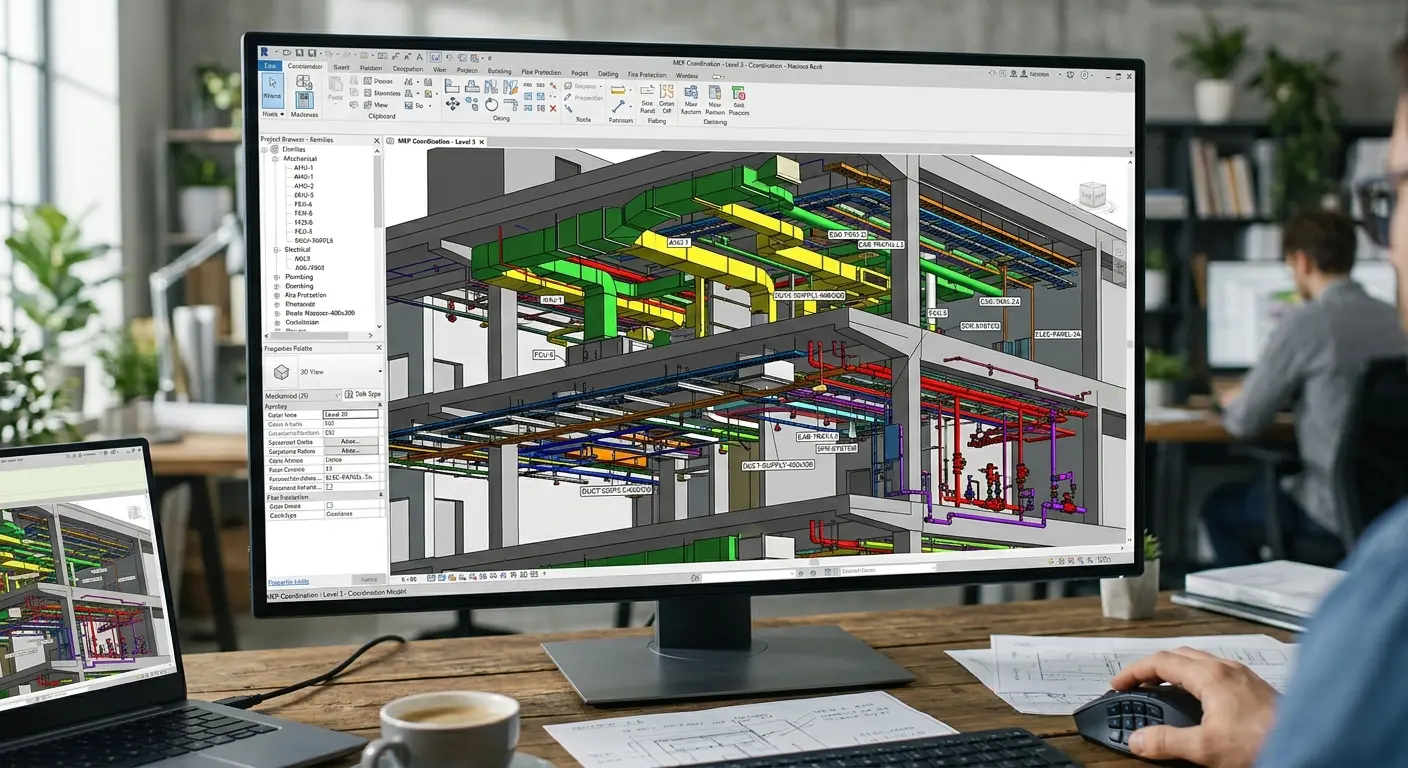
Let’s talk about clash detection. Modern educational spaces are heavily wired and highly sensitive to ventilation. If you wait to resolve plenum depths, duct routes, and major equipment zones until after the ceiling heights are locked, you are actively sabotaging the build.
Use key sections and generate enlarged details.
| Drafting Element | Why It Matters Early On |
| Return Ducts | Show exactly where they cross structural beams to avoid sudden drop-ceiling crises. |
| Pendant Lights | Pinpoint where they sit so they don’t fight with sprinkler heads. |
| Diffusers | Specify landing spots to ensure airflow actually covers the classroom layout. |
Mechanical rooms are not magic black boxes. Draft them with strict service clearances. Detail the oversized door frames needed to swap out a commercial boiler ten years from now. Map the physical replacement paths.
Furthermore, flag roof penetrations and drains on the architectural set, not just the MEP sheets. Small, deliberate coordination notes in your Revit model prevent massive, expensive field changes later. Reserve empty wall chases now for future cabling and security upgrades.
Make The Sheet Easy To Use In The Field
Here is the golden rule of architectural drafting: A beautiful drawing set is entirely useless if a foreman standing in the rain cannot read it. Your CAD files must answer questions instantly.
Keep the sheet order ruthlessly predictable. Standardize your symbols. Ensure callouts are impossible to misinterpret. Also, the room numbers must match across floor plans, reflected ceiling plans (RCPs), finish schedules, and hardware sets. A single mismatch here generates an instant RFI.
Interior elevations require strictly defined extents. Provide enough graphic data to show tricky junctions and built-in millwork conditions without cluttering the page.
Phasing and alternates happen. All you have to do is separate them. Use distinctly different line weights and bold notes to isolate future phases from current work. Do a physical field check before issuing. Print the sheets out at half-size. Are they still legible? Even something as simple as pasting a key plan in the corner of every single sheet saves hours of wasted navigation time on a sprawling site.
The Bottom Line
Modern school projects do not succeed by accident. They succeed when architectural drawings aggressively reduce uncertainty. So, try drafting with repeatable grids and prioritizing highly readable life-safety intent. Force early MEP alignment and demand environment-first detailing. When your CAD drafting or BIM modeling is legible and highly consistent, bids come in cleaner. Coordination meetings run shorter. Most importantly, the finished school actually serves its students and community flawlessly on day one.
Frequently Asked Questions
Why is BIM better than traditional CAD for school design?
BIM creates a centralized, 3D data model. This enables automated clash detection between architectural, structural, and MEP systems, saving massive amounts of money and time during the actual construction phase of modern, complex school buildings.
How do soft walls improve a school’s lifespan?
Soft walls, like demountable partitions, allow facilities to reconfigure floor plans cheaply as educational needs change. This keeps the building relevant for decades without requiring heavy, expensive demolition or massive structural overhauls during summer breaks.
What role does architectural drafting play in school security?
Drafters map out crucial security features. They define clear lines of sight, strategically locate secure entry vestibules, and carefully route circulation paths to separate student populations from external delivery and service personnel, minimizing potential risks.
Why should architectural sets show roof penetrations?
Relying solely on MEP sheets for roof penetrations causes fatal coordination errors. Putting them on the architectural set ensures the structural team and roofers properly plan for flashing, structural supports, and long-term waterproofing during construction.
How can drafting improve acoustic performance in classrooms?
By explicitly detailing full-height partitions that extend all the way to the structural deck, drafters prevent sound from bleeding over drop ceilings. Noting specific STC ratings on wall assemblies ensures builders use the correct insulation.
What is a key plan, and why use it?
A key plan is a small, simplified map placed on every drawing sheet. It highlights the specific sector of the building being detailed, helping contractors instantly orient themselves within massive, sprawling modern school campuses.
How do you draft for future technology upgrades?
You draft specifically by reserving oversized vertical chases and accessible ceiling plenums in the BIM model. This ensures future IT teams can easily run new security cabling, fiber optics, or power lines without destroying walls.