Enhancing Efficiency in Public Facility Design with CAD and BIM
Unlocking true public facility design efficiency starts with embracing the power of modern tools. When two factors, such as time constraints and budgets, are considered in a project using traditional means, is going to cause expensive delays. Enabling the visualization of any design, coordination, and optimization, CAD BIM advantages allow architects and engineers to do so like never before. With the help of our years of professional experience, we are revealing how BIM could help to make the complicated planning of the facilities a simple task with a high degree of accuracy.
This blog discusses the opportunities of CAD and BIM to address typical design issues and make the projects of the publicly accessible facilities efficient to save time and resources and guarantee the high quality of the results.
What is CAD vs BIM in Facility Design?
Step into the future of facility design with tools that do more than just draw lines. Although computer-aided design has supported architectural and structural drafting over several decades, enabling the ability to create accurate 2D and 3D drawings, understanding what is CAD is essential before moving toward data-driven BIM workflows.. It is not only a BIM in creating models, but it is also data, collaboration, and lifecycle management in all project phases.
Comparison of CAD vs BIM
- CAD (Computer-Aided Design) is mostly used to sketch small-scale drawings. Simple both in 2D and 3D designs and lacks embedded information as well as real-time collaboration.
- BIM (Building Information Modeling) is an intelligent model type system, which is a combination of geometry, 4D schedule, 5D cost, and lifecycle information. Enables conflict detection, time tracking updates, and improved coordination among the stakeholders.
Did you know? Building projects that apply BIM experience result in up to 40% fewer mistakes in the construction process and can save 30-50% of design coordination costs than the usual CAD processes.
CAD vs BIM Features
| Feature | CAD | BIM |
| Drafting | Yes | No |
| 3D Modeling | Yes | No |
| Data-Driven | No | Yes |
| Clash Detection | No | Yes |
| Lifecycle Support | No | Yes |
To further explore the topic, refer to CAD vs BIM explained to understand why modern projects are being inclined towards BIM to gain efficiency, accuracy, and long-term value.
Key Benefits of Using CAD and BIM in Public Facility Design
Improved Accuracy and Precision
CAD gives a designer the opportunity to make detailed and precise drawings, thereby preventing errors in design. This protects the fact that everything is correct even prior to construction. BIM goes an extra mile in combining data from different parts of the design like architecture, structure and plumbing into one design. This helps to determine the problems at an early stage and the design process is more accurate.
Enhanced Collaboration and Communication
BIM also allows team members to collaborate. Designers, contractors, and engineers can view, update and make changes to the identical 3D model in real time and this minimizes errors and accelerates approvals. The change is automatically tracked, and that is the reason no one would be left out. In the meantime, CAD gives BIM a helping hand by giving more accurate design information that can be easily distributed to all stakeholders, maintaining everyone on track throughout the entire process from concept to actual construction.
| Metric | BIM Benefit |
| Coordination time | 66% |
| Project duration | 50% |
| Cost savings | Approx 20–50% |
| RFI reduction | 47–74% |
Cost and Time Efficiency
CAD and BIM contribute to the minimization of errors and modifications that may save a significant amount of finances and time. BIM assists in identifying the issues in design at an early stage. Therefore, they are not the cause of delays and the extra expenses incurred during the construction process. The elaborate drawings that are produced by CAD also help in avoiding mistakes, and this gives an assurance that one will not make as many costly errors once the project is in progress. This leads to an efficient design process as a whole.
Why CAD + BIM Matters for Public Facility Design?
Public facility design is a complicated puzzle, and it has many parties and time constraints. All the architects, engineers, contractors, and city planners should work in harmony and the conventional ways tend to cause bottlenecks. This is where BIM comes in. It breaks down silos because all project data is centralized. Therefore, real-time collaboration can be achieved, and costly miscommunicationscan be minimized. For large public facility projects, having a structured implementation strategy is critical, which is why a well-defined BIM Execution Plan
Regulatory and safety compliance is also taken care of at the earliest through BIM. Thus reducing the chances of delays due to code violations or redoing work. From hospitals to airports, the utilization of BIM assists teams in finding clashes, workflow optimization, and scheduling projects.
- BIM can reduce overall project costs by approximately 20%.
- BIM implementation can accelerate project schedules by approx 30%
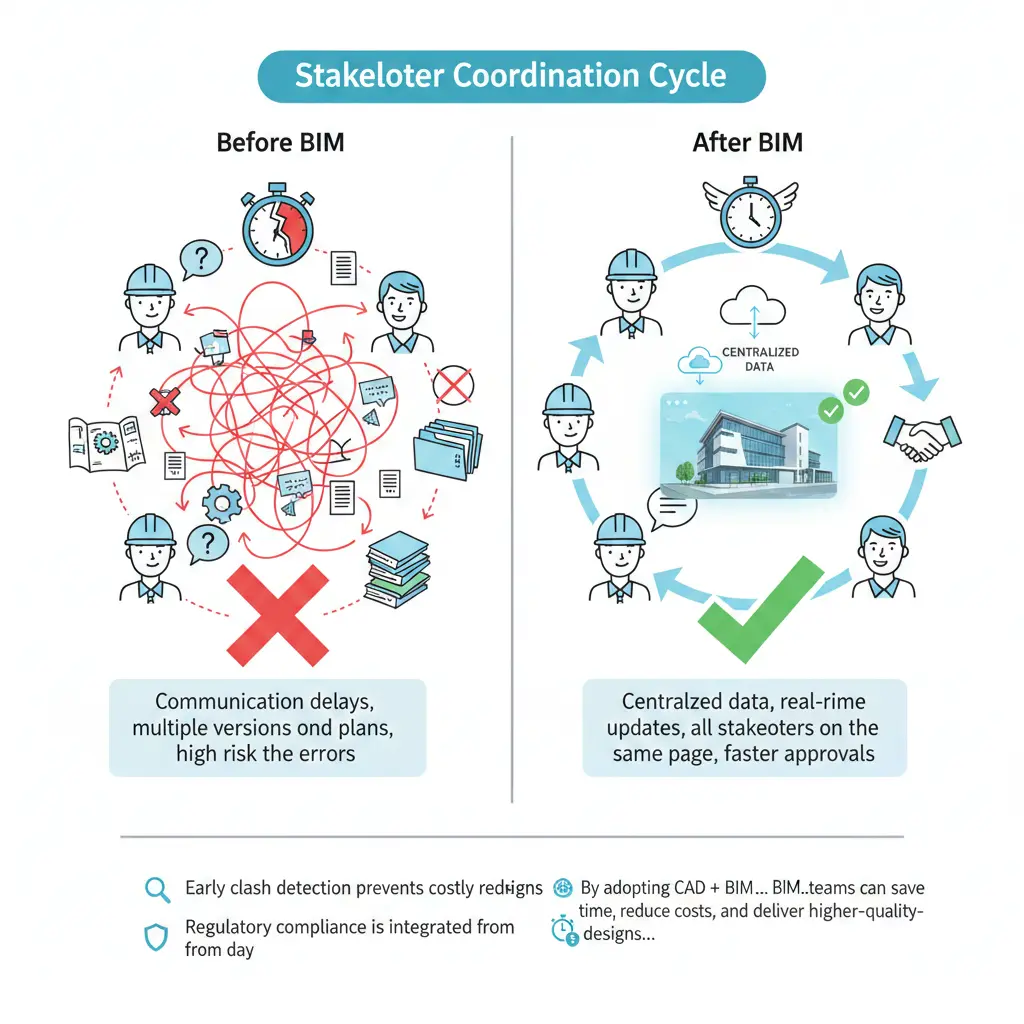
Before BIM: There was a delay in communication, several plans, and there was a high probability of error.
After BIM: Single database, real-time updates, everybody at the same place, quicker approvals.
Benefits of this:
Benefits of this:
- The efficiency is enhanced by centralized modeling.
- Costly redesigns are avoided in early clash detection.
- There is regulatory compliance at the very beginning.
Optimising the Design of Public Facilities with CAD and BIM
Streamlined Planning and Visualisation
CAD and BIM facilitate the process of planning by making proper and detailed designs that are easy to comprehend. The 3D models enable the stakeholders to have a full picture of the entire facility, and hence, it is easier to consider the layout, functionality, and movement of space.
Such a visual representation enables all participants in the project to make decisions and reach an agreement on the choice of design in a short time. As an animal shelter, for example, such a strategy guarantees the functionality of the layout to the requirements of the facility and to the well-being of the animals.
Design Efficiency in Complex Facilities
Facilities used by the general population usually have an array of building systems, such as structural, mechanical, electrical, and plumbing (MEP). With BIM, every one of these systems can be combined into a single digital model, and thus the possible conflicts may be identified easily before the actual construction process starts.
Such coordination reduces expensive problems in the course of construction. Likewise, the capability of CAD to produce very specific designs fulfills the role of making sure that every component of the project can be easily altered or altered. This will help in speeding up the decision-making process and get the project on time.
Sustainability and Energy Efficiency
CAD and BIM assist in achieving the support sustainability goals since they allow simulating energy consumption and environmental performance. Specifically, BIM can be used to streamline the design of such systems, such as heating, ventilation, and air conditioning (HVAC), to minimize the waste of energy and decrease the operating budget.
Moreover, CAD aids in the optimization of materials, in which case designers can select the most sustainable and economical materials. All these tools combined will result in the fact that public facilities, such as animal shelters, are in compliance with modern environmental standards and are long-term energy-efficient.
CAD Benefits for Detailed Architectural Design
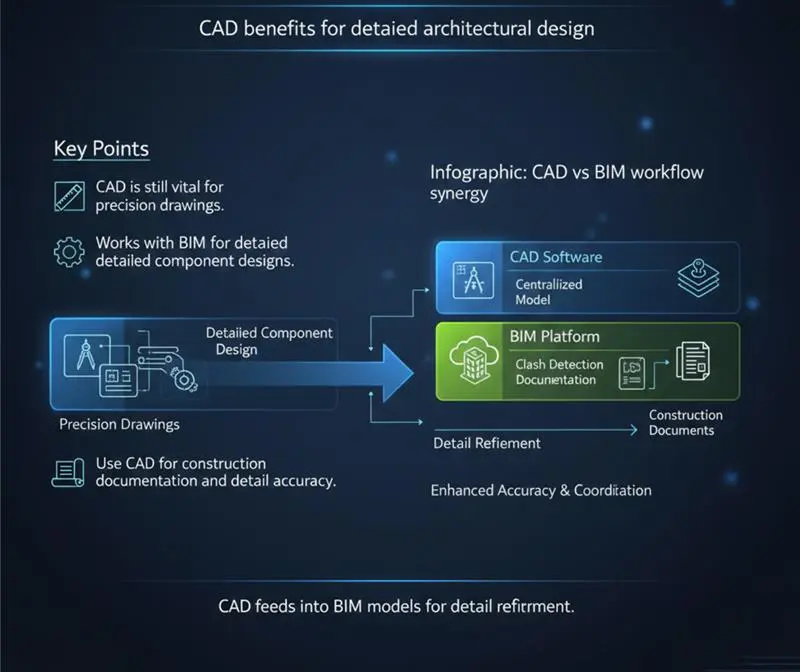
CAD is still a critical component of accuracy and precision, even with the age of smart modeling. Whereas BIM deals with intricate modeling and data combination, CAD makes sure that no line, dimension, or detail is out of place. CAD enables architects and engineers to develop precise, consistent, and construction-ready designs, whether it is an intricate floor layout or detailed component layouts.
Precision in Component Design
CAD goes in collaboration with BIM. Whereas BIM offers an all-inclusive 3D model consisting of a schedule and cost data, CAD introduces detailed drawings in the model, which are precise to the component level. This symbiosis helps avoid making mistakes in the process of building and avoids expensive changes.
Construction Documentation and Detail Accuracy
CAD drawings are very important in construction documentation. Accurate plans, sections, and elevations minimize misunderstanding at the site, allow the contractors to work according to exact requirements, and satisfy building codes. Research findings indicate that projects that incorporate CAD in their elaborate design result in fewer than 20% of the mistakes found at the site than projects that apply BIM exclusively.
Public Facility BIM Case Studies
It is true that seeing is believing and BIM not only looks good on paper but it provides tangible outcomes in real-world projects of the publication of facilities in the world. BIM makes the design, construction, and operation processes easier in hospitals, airports and government complexes. This will help the team to save time, reduce costs, and improve the overall quality of the undertaking.
Hospitals: Streamlining MEP Coordination
In complicated medical institutions, mechanical, electrical, and plumbing (MEP) systems play a significant role. BIM ensures that there is proper coordination of all systems that take place even before the construction begins, thereby reducing the change orders and minimizing costly construction delays.
Airports: Optimizing Workflows and Passenger Flow
Airports are large, multi-stratified constructions, and their components are in constant motion. The BIM enables the project teams to simulate the traffic of people, plan layouts, and organize several contractors in a synchronous mode, which facilitates easier processes after construction. The BIM has enabled the airport projects to reduce the average construction time by more than three months, which has enhanced the effectiveness of the overall projects.
Government Complexes: Enhancing Maintenance Planning
The industrial facilities of the government need long-term efficiency of the operations. BIM offers facility management in a digital model offering teams to plan the maintenance, asset tracking, and minimize the lifecycle costs. This case study example shows that the duration of projects could be shortened by 89-104 days in the case of the complete implementation of BIM, between the design and handover.
5D BIM Lifecycle Benefits, Operations, and Maintenance
The benefits of BIM do not just stop at the level of design and construction, but it also able to provide advantages in the entire lifecycle of the facility. Hospitals and government complexes are just one example of public facilities that can use 5D BIM to enhance their work, simplify the maintenance process, and plan renovations more efficiently. BIM can change the manner in which facility managers manage assets and sustain them in the long term by means of combining digital models with real-time data. When combined with advanced lifecycle strategies such as digital twins and real-time monitoring, digital twin workflows and IoT further enhance the operational efficiency and sustainability of public facilities.
Facility Lifecycle Management Made Easy
BIM enables the full facility lifecycle management (FM). Teams may also have access to digital models, using which details about assets can be tracked, maintenance and upgrades scheduled and planned. This reduces the instances of unexpected downtime and the plant is operating at maximum capacity.
Enhancing Sustainability and Energy Efficiency
Using BIM, the energy performance modelling and sustainability analysis can be conducted at a much earlier stage of design. Plants can streamline lighting, HVAC and other energy systems, which equates to the saving of costs and reduces the carbon footprint.
| Phase | BIM Benefit | Details / Impact |
| Concept | Early clash detection | Identify design conflicts before construction, saving time and costs. |
| Design | Accurate BOQs | Generate precise bills of quantities for better budgeting and material planning. |
| Construction | Fewer errors | Minimize on-site mistakes through coordinated 3D models and updated drawings. |
| Operation | Digital maintenance data | Maintain a digital record of assets, systems, and schedules for efficient facility management. |
Main points
- BIM provides actionable insights from concept to operation.
- 5D BIM supports cost, scheduling, and lifecycle efficiency.
- Cloud integration and digital twin maximize value, long-term value and sustainability.
Common Challenges and Solutions in Public Facilities
Implementation of BIM in projects related to the development of a public facility may change the results, yet it is not devoid of challenges. The awareness of these barriers and the use of effective solutions can guarantee the success, savings in costs, and performance maximization.
Resistance to Change and Training Gaps
The reason why many teams hesitate to use BIM because it involves the need to learn new workflows and tools. The architects, engineers, and contractors might feel at ease with the conventional CAD.
Solution: Provide organized training sessions and step-by-step adoption measures. Research indicates that formal BIM training offered by companies enhances the efficiency of a project by 25-30%.
Initial Investment Concerns
The large initial expenses on software, hardware, and licensing might be a scare away for public facility managers.
Solution: consider long-term ROI. BIM saves time, mistakes, and rework, which can save 15-20% of the entire project life. BIM solutions based on the cloud save hardware costs as well.
Get expert CAD & BIM solutions today
Data Interoperability Issues
It can be challenging to share BIM data with several software platforms and parties. Various file formats and standards can become inefficient.
Solution: Implement open BIM standards (IFC/COBie) and make sure that all stakeholders are trained in the compatible tools. Open standard projects are said to have easier collaboration and to have 20% fewer delays caused by data.
Conclusion
Unlock the Full Potential of Your Public Facility Projects
CAD and BIM are changing the processes of planning, construction, and maintenance of public facilities, both in design and operations. These tools result in quantifiable efficiencies in reducing costs up to 20 percent, schedules 30%, and errors during the project development process.
An investment in CAD and BIM solutions will translate to smarter, faster, and more sustainable projects of the public facilities. Whether you are dealing with hospitals, airports, or government complexes, you are bound to make use of such technologies to be accurate, compliant, and efficient in terms of operational efficiency in the long run.
Ready to take your facility design to the next level?
Contact CAD Drafter to receive individual CAD and BIM design services on your next public facility project and enjoy the benefits of professional public facility BIM services and the latest CAD BIM solutions.
FAQs
What is the difference between CAD and BIM in public facility design?
CAD is concerned with 2D/3D accuracy in drafting and detailed drawings, whereas BIM offers intelligent and data-driven 3D models with in-built scheduling, costs, and lifecycle management. BIM allows two or more stakeholders to work together and minimizes errors during the project.
What is the efficiency of BIM in the work of public facility projects?
BIM pulls the data of architects, engineers, and contractors together, improving the collaboration, allowing them to detect clashes and simplify approvals. Research reveals that BIM can save up to 20% on costs and short schedule by 30% versus conventional approaches.
Are CAD and BIM applied simultaneously or independently?
They work together. CAD provides the step-by-step component drawings, whereas BIM incorporates the same into smart models. This synergy will guarantee macro-level coordination by micro-level precision, which minimizes construction errors and rework.
What types of public facilities benefit most from BIM?
It is very beneficial to hospitals, airports, and government complexes. BIM is used to coordinate the MEP systems, streamline the traffic of people, and organize the long-term maintenance, enhancing the quality of the project and operational efficiency.
What are the general issues of BIM implementation in governmental facilities?
The issues are resistance to change, training gap, high start-up cost, and the problem of interoperability of the data. These solutions include organized education, gradual implementation, cloud computing, and open BIM standards.
What is the role of BIM in the planning of the lifecycle and maintaining facilities?
BIM offers operations and maintenance digital models and real-time data. Facility managers are able to keep track of assets, maintenance schedule and make renovation plans easily. BIM has been found to hand over projects and maintenance planning 30-40 times faster.
Why should I prefer BIM/CAD professional services for public facilities?
With the help of professional CAD/BIM services, there are good drawings, data-based models, adherence to regulations, and smooth cooperation. The result of this is cost savings, increased project execution speed, and operational efficiency.